ગુ
ગુ
આ લેખ હજી આ ભાષામાં ઉપલબ્ધ નથી, તેથી અંગ્રેજીમાં બતાવ્યો છે.
The Maa Baglamukhi Ashtottara Shatanam Stotram (माँ बगलामुखी अष्टोत्तर शतनाम स्तोत्र) is a powerful hymn containing the 108 sacred names of Maa Baglamukhi, the eighth Mahavidya. This stotra is a direct invocation of her Stambhan Shakti - the divine power to paralyze, silence, and defeat negative forces. According to the Rudrayamala Tantra, reciting these names grants devotees victory in legal battles, protection from enemies, and control over adverse situations. It's not just a prayer; it's an armour.
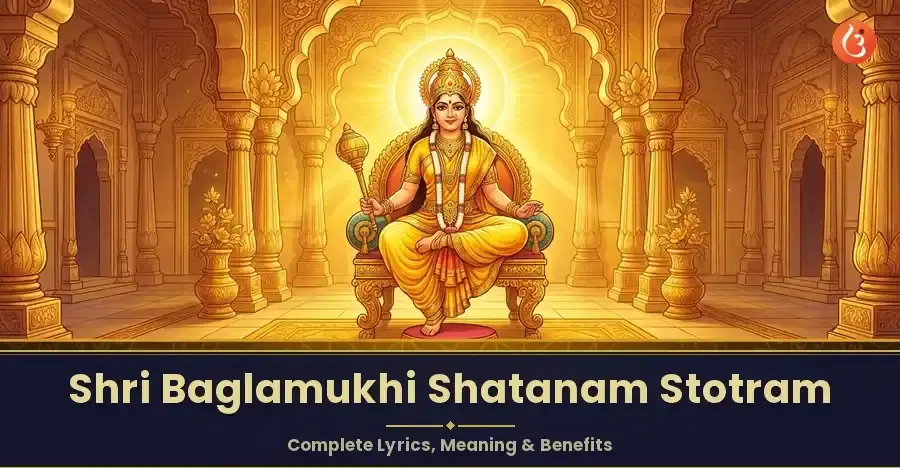
Maa Baglamukhi, also known as Pitambara Devi, is the eighth of the ten Dasa Mahavidyas. Her identity is rooted in Tantra, where she represents the formidable power to bring all motion to a standstill. According to scriptural lore, she emerged from the Haridra Sarovar (a lake of turmeric) to calm a cosmic storm stirred by a demon. This origin explains her affinity for the color yellow and her name Pitambara, "the one adorned in yellow." The temple trust at the Baglamukhi Temple in Kangra describes her iconography as pulling a demon's tongue, which perfectly symbolizes her primary function: silencing evil speech, stopping gossip, and neutralizing any opposition.
She isn't a goddess you turn to for gentle blessings. You turn to her for victory. Her energy is fierce, direct, and incredibly effective for devotees facing overwhelming external challenges. This makes her worship essential for those in legal professions, politics, or anyone dealing with public disputes.
The most authentic source for this stotra is the Rudrayamala Tantra, a foundational text of Hindu Tantrism. This text doesn't just list the names; it explains that each name is a mantra that activates a specific aspect of the goddess's cosmic power. In the Tantric view, these names are not mere labels; they are sonic embodiments of the deity. Each name is a mantra-anga (a limb of the core mantra), vibrating at a precise frequency to invoke her presence. Chanting "Vadini" invokes her power over speech, while "Gada-Hasta" calls upon her ability to strike down obstacles.
Unlike some stotras that evolved through oral folk traditions, this one is considered a direct revelation, preserved meticulously by Tantric masters. Why 108 names? In Vedic cosmology, the number 108 represents the entirety of existence, so reciting the 108 names is a way of acknowledging and invoking the goddess in her complete, all-powerful form. It's a comprehensive spiritual tool.
Om, I bow to the Goddess Baglamukhi.
Om Bagalayai Namah
Om Vishnu-Vanitayai Namah
Om Vishnu-Shankara-Bhaminyai Namah
Om Bahu-Stambhana-Karyai Namah
Om Bahu-Vidya-Visharadai Namah
Om Brahma-Vidyayai Namah
Om Maha-Vidyayai Namah
Om Brahma-Vishnu-Shivatmakayai Namah
Om Brahmanand-Swarupinyai Namah
Om Brahmastra-Rupinyai Namah
Om Bhakta-Daridrya-Shamanayai Namah
Om Bhakta-Sanjivanyai Namah
Om Bhakta-Kama-Dughayai Namah
Om Bhakta-Bhava-Nivasinyai Namah
Om Bhadra-Rupayai Namah
Om Bhadra-Kalayai Namah
Om Bhadra-Bhu-Priya-Karinyai Namah
Om Bhuvaneshwaryai Namah
Om Bhuvanakaryai Namah
Om Bhuvanakara-Karinyai Namah
Om Chaturbhujayai Namah
Om Chatur-Vaktrayai Namah
Om Chatur-Varga-Phala-Pradayai Namah
Om Charu-Rupayai Namah
Om Chidanandayai Namah
Om Chinmayayai Namah
Om Chitswarupinyai Namah
Om Daksha-Kanyayai Namah
Om Deva-Matre Namah
Om Deva-Durga-Vimochinyai Namah
Om Daya-Rupayai Namah
Om Dayakaryai Namah
Om Deva-Deva-Prapujitayai Namah
Om Dhumravati-Swarupayai Namah
Om Dhumra-Lochan-Mardinyai Namah
Om Gada-Hastayai Namah
Om Gaganakaryai Namah
Om Gambhirayai Namah
Om Gana-Sevitayai Namah
Om Gauri-Shankari-Rupayai Namah
Om Gaja-Vaktr-Prapujitayai Namah
Om Haya-Griva-Priya-Karinyai Namah
Om Haya-Griva-Prapujitayai Namah
Om Halahala-Swarupinyai Namah
Om Jagan-Matre Namah
Om Jagan-Mohinyai Namah
Om Jagan-Maya-Swarupinyai Namah
Om Jihva-Stambhana-Karinyai Namah
Om Jihva-Kila-Swarupinyai Namah
Om Kali-Kalmasha-Nashinyai Namah
Om Karuna-Sagara-Rupayai Namah
Om Kubera-Priya-Karinyai Namah
Om Kubera-Prapujitayai Namah
Om Kula-Devyai Namah
Om Kula-Shreshthayai Namah
Om Kula-Yoginyai Namah
Om Maha-Lakshmyai Namah
Om Maha-Mayayai Namah
Om Maha-Mohinyai Namah
Om Maha-Patal-Gamini-Rupayai Namah
Om Madhu-Mams-Priya-Karinyai Namah
Om Madhu-Mams-Prapujitayai Namah
Om Mudgara-Hastayai Namah
Om Muni-Priya-Karinyai Namah
Om Muni-Prapujitayai Namah
Om Nitya-Swarupinyai Namah
Om Nitya-Klinnayai Namah
Om Nitya-Mangalayai Namah
Om Para-Brahma-Swarupinyai Namah
Om Para-Shakti-Swarupinyai Namah
Om Para-Vidya-Swarupinyai Namah
Om Paramananda-Rupinyai Namah
Om Pasha-Hastayai Namah
Om Pasha-Vimochinyai Namah
Om Pitambara-Dharayai Namah
Om Pita-Pushpa-Priyayai Namah
Om Pita-Gandhanulepanayai Namah
Om Praneshwaryai Namah
Om Prana-Rupinyai Namah
Om Prana-Sanjivanyai Namah
Om Rakta-Vastra-Dharayai Namah
Om Rakta-Pushpa-Priyayai Namah
Om Rakta-Bali-Priyayai Namah
Om Rudra-Rupinyai Namah
Om Rudra-Mohinyai Namah
Om Rudra-Priya-Karinyai Namah
Om Sarva-Deva-Mayyai Namah
Om Sarva-Siddhi-Pradayinyai Namah
Om Sarva-Stambhana-Karinyai Namah
Om Sarva-Vighna-Vinashinyai Namah
Om Sarva-Shatru-Kshayankaryai Namah
Om Sarva-Mangala-Mangalyayai Namah
Om Sarva-Saukhya-Pradayinyai Namah
Om Sarva-Shakti-Mayyai Namah
Om Sarva-Sampat-Pradayinyai Namah
Om Shav-Vahanayai Namah
Om Shava-Munda-Dharinyai Namah
Om Shmashana-Vasinyai Namah
Om Shmashana-Priya-Karinyai Namah
Om Shuddha-Vidya-Swarupinyai Namah
Om Siddha-Vidyayai Namah
Om Siddha-Matre Namah
Om Siddheshwaryai Namah
Om Stambhana-Karyai Namah
Om Stambhana-Vidyayai Namah
Om Sthira-Rupayai Namah
Om Sthira-Karyai Namah
Om Sthira-Buddhi-Pradayinyai Namah
Understanding the names transforms recitation from a ritual into a deep, meaningful practice. Here’s what some of the key names signify, as interpreted by Tantric acharyas.
These initial names establish her supreme status. Brahma-Vidyayai (She who is the knowledge of Brahman) and Brahmastra-Rupinyai (She who is the form of the ultimate celestial weapon) show she isn’t just a deity; she is the ultimate power and knowledge itself.
Names like Gada-Hastayai (She who holds a mace) and Mudgara-Hastayai (She who wields a hammer) highlight her warrior nature. These aren't symbolic weapons. They represent her ability to actively crush obstacles, enemies, and negative karmic patterns in a devotee's life.
This is her core function. Jihva-Stambhana-Karinyai (She who paralyzes the tongue) is her most famous power. Sarva-Stambhana-Karinyai (She who paralyzes everything) expands this to all forms of opposition, whether it's a legal opponent's argument or the progress of a disease. It's the ultimate 'stop' command.
Though known for her fierce power, she also embodies prosperity. Names like Maha-Lakshmyai (The Great Goddess Lakshmi) and Sarva-Sampat-Pradayinyai (The bestower of all types of wealth) reveal that by stopping negativity and obstacles, she clears the path for abundance to flow into a devotee's life.
Sarva-Shatru-Kshayankaryai means "She who destroys all enemies." This isn't just about external foes; it includes internal enemies like doubt, fear, and ego. The final name, Sthira-Buddhi-Pradayinyai (She who grants a stable and firm intellect), reveals the true prize: a calm, unshakable mind, free from the chaos of conflict. That's the real victory.
Reciting the 108 names is a potent sadhana with tangible results, as documented in both scripture and devotee experiences. It's not a passive prayer. It's a strategic spiritual practice.
To get the full benefit, you can't just read the words. Following the correct vidhi (procedure) aligns your energy with the goddess's, as prescribed by Vaidik pandits. It’s a discipline.
For those facing serious challenges, personal recitation can be powerfully amplified by professional pujas performed by verified pandits. These rituals channel the goddess's energy with precision and intensity.
Recommended Pujas on Utsav:
When you Participate through Utsav, pandits perform the Sankalp using your name and gotra, and you receive a video of the puja and authentic prasad from the temple.
The Maa Baglamukhi Ashtottara Shatanam Stotram is not attributed to a human sage but is considered a divine revelation. Its canonical source is the Rudrayamala Tantra, a foundational text of the Bhairava Agama tradition composed in classical Sanskrit around the 10th-13th century CE. Within this scripture, the stotra is presented as a sacred dialogue between Lord Shiva (as Bhairava) and Goddess Parvati (as Bhairavi).
श्री भैरव उवाच
श्रृणु देवि प्रवक्ष्यामि बगलास्तोत्रमुत्तमम्।śrī bhairava uvāca
śṛṇu devi pravakṣyāmi bagalāstotramuttamam |
Lord Shiva reveals these 108 names and their immense power directly to the Goddess. For centuries, this knowledge has been transmitted meticulously through the guru-shishya parampara (master-disciple lineage) of the Tantric schools, ensuring its esoteric integrity and ritual potency remain intact.

રાહુ પૈઠાણી મંદિર, પૈઠાણી
શનિવાર - 28 નવેમ્બર, 2026 - Shanivar Visesh