
ગુ
ગુ
આ લેખ હજી આ ભાષામાં ઉપલબ્ધ નથી, તેથી અંગ્રેજીમાં બતાવ્યો છે.
The Shri Tulsi Stotram (श्री तुलसी स्तोत्रम्) is a powerful hymn dedicated to Goddess Tulsi, the sacred plant embodying Goddess Lakshmi. According to the Padma Purana, Uttara Khanda, this stotram was composed by the sage Pundarika to honor Tulsi's unwavering devotion to Lord Vishnu. Chanting it is believed to grant spiritual purity, remove obstacles, and attract the blessings of both Vishnu and Lakshmi. It's a cornerstone of daily worship for millions of devotees.

This stotram isn't just a folk prayer; it has deep scriptural roots. The authoritative source for the Shri Tulsi Stotram is the Padma Purana (पद्म पुराण), one of the major eighteen Puranas. Specifically, it appears in the Uttara Khanda section, where its origin is attributed to the great sage Pundarika.
What does this mean for you? It means you're chanting a hymn with a direct, unbroken lineage going back centuries, recognized and revered by countless acharyas. Pundarika composed it to capture the essence of Tulsi's divine nature as Vishnu's beloved (Vishnu-priya). This isn't just poetry; it's a spiritual key handed down through scripture.
To truly understand the stotram's power, you need to know Tulsi's story. According to the Puranas, she was Vrinda, the exceptionally devout wife of the demon-king Jalandhar. Her pativrata dharma (wifely devotion) was so immense that it created an impenetrable shield of protection around her husband, making him invincible. Not even Lord Shiva could defeat him.
The gods turned to Lord Vishnu for help. Vishnu, knowing that Jalandhar's power was tied to Vrinda's purity, took the form of Jalandhar and broke her vow. Once her shield was gone, Shiva defeated the demon. When Vrinda realized the deception, she was heartbroken but, as a true devotee, she forgave Vishnu. Lord Vishnu, moved by her piety, blessed her to be eternally by his side as the sacred Tulsi plant. This is why no Vishnu puja is complete without Tulsi leaves. It's a promise kept for eternity.
जगद्धात्रि नमस्तुभ्यं विष्णोश्च प्रियवल्लभे ।
यतो ब्रह्मादयो देवाः सृष्टिस्थित्यन्तकारिणः ॥१॥Jagaddhatri namastubhyam vishnoshcha priyavallabhe |
Yato brahmadayo devah srishtisthityantakarinah ||1||नमस्तुलसि कल्याणि नमो विष्णुप्रिये शुभे ।
नमो मोक्षप्रदे देवि नमः सम्पत्प्रदायिके ॥२॥Namastulasi kalyani namo vishnupriye shubhe |
Namo mokshaprade devi namah sampatpradayike ||2||तुलसी पातु मां नित्यं सर्वापद्भ्योऽपि सर्वदा ।
कीर्तितापि स्मृता वापि पवित्रयति मानवम् ॥३॥Tulasi patu mam nityam sarvapadbhyo'pi sarvada |
Kirtitapi smrita vapi pavitrayati manavam ||3||नमामि शिरसा देवीं तुलसीं विलसत्तनुम् ।
यां दृष्ट्वा पापिनो मर्त्या मुच्यन्ते सर्वकिल्बिषात् ॥४॥Namami shirasa devim tulasiṁ vilasattanum |
Yam drishtva papino martya muchyante sarvakilbishat ||4||तुलस्या रक्षितं सर्वं जगदेतच्चराचरम् ।
या विनिहन्ति पापानि दृष्ट्वा वा पापिभिर्नरैः ॥५॥Tulasya rakshitam sarvam jagadetachcharacharam |
Ya vinihanti papani drishtva va papibhirnaraih ||5||नमस्तुलस्यतितरां यस्यै बद्ध्वाञ्जलिं कलौ ।
कलयन्ति सुखं सर्वं स्त्रियो वैश्यास्तथाऽपरे ॥६॥Namastulasyatitaram yasyai baddhvanjalim kalau |
Kalayanti sukham sarvam striyo vaishyastatha'pare ||6||तुलस्या नापरं किञ्चिद् दैवतं जगतीतले ।
यथा पवित्रितो लोको विष्णुसङ्गेन वैष्णवः ॥७॥Tulasya naparam kinchid daivatam jagatitale |
Yatha pavitrito loko vishnusangena vaishnavah ||7||तुलस्याः पल्लवं विष्णोः शिरस्यारोपितं कलौ ।
आरोपयति सर्वाणि श्रेयांसि वरमस्तके ॥८॥Tulasyah pallavam vishnoh shirasyaropitam kalau |
Aropayati sarvani shreyansi varamastake ||8||तुलस्यां सकला देवा वसिन्ति सततं यतः ।
अतस्तामर्चयेल्लोके सर्वान् देवान् समर्चयन् ॥९॥Tulasyam sakala deva vasanti satatam yatah |
Atastamarchayelloke sarvan devan samarchayan ||9||नमस्तुलसि सर्वज्ञे पुरुषोत्तमवल्लभे ।
पाहि मां सर्वपापेभ्यः सर्वसम्पत्प्रदायिके ॥१०॥Namastulasi sarvajne purushottamavallabhe |
Pahi mam sarvapapebhyah sarvasampatpradayike ||10||इति स्तोत्रं पुरा गीतं पुण्डरीकेण धीमता ।
विष्णुमर्चयता नित्यं शोभनैस्तुलसीदलैः ॥११॥Iti stotram pura gitam pundarikena dhimata |
Vishnumarchayata nityam shobhanaistulasidalaih ||11||यः पठेत्तच्च वै भक्त्या सोऽपि विष्णोः प्रियो भवेत् ॥१२॥
Yah pathettachcha vai bhaktya so'pi vishnoh priyo bhavet ||12||
Here’s what you're actually saying when you chant this beautiful stotram. It's not just sound; it's profound meaning.
Verse 1: "I bow to you, O supporter of the world, who is the dearest beloved of Lord Vishnu. From you, even Brahma and the other gods receive their powers to create, sustain, and end the universe."
Verse 2: "Salutations to you, O Kalyani (bringer of auspiciousness), beloved of Vishnu. O auspicious one, I bow to you, the giver of liberation (moksha) and the bestower of wealth (sampatti)."
Verse 3: "May Tulsi protect me always and forever from all calamities. Merely chanting her name or even thinking of her purifies a person." (This is so powerful!)
Verse 4: "I bow my head to the divine Tulsi, whose form is radiant. Just by seeing her, even sinful mortals are freed from all their wrongdoings."
Verse 5: "This entire universe, with all its moving and non-moving beings, is protected by Tulsi. She destroys sins, even when seen by the sinful."
Verse 6: "I bow to Tulsi, by offering prayers to whom in the age of Kali, everyone - women, merchants, and others - attains all happiness."
Verse 7: "There is no other deity on this earth comparable to Tulsi. Just as a person becomes a Vaishnava through association with Vishnu, the world is purified by her."
Verse 8: "In the age of Kali, offering a single Tulsi leaf on the head of Lord Vishnu bestows all the highest blessings upon the devotee."
Verse 9: "All the gods continuously reside in Tulsi. Therefore, by worshipping her, one worships all the deities."
Verse 10: "Salutations to you, O all-knowing Tulsi, beloved of the Supreme Being (Purushottama). Please protect me from all my sins and grant me all forms of wealth."
Verse 11: "This hymn was originally sung by the wise Pundarika, who worshipped Lord Vishnu daily with beautiful Tulsi leaves."
Verse 12: "Whoever recites this with devotion will also become dear to Lord Vishnu."
Chanting this stotram, as confirmed by the Phala Shruti (the final verses describing the benefits), brings profound changes. It's more than just a ritual.
To get the full benefits, here’s a simple yet authentic method recommended by pandits.
While chanting the Tulsi Stotram daily is ideal, certain days amplify its spiritual energy. According to Vedic tradition, these are the best times.
| Day/Tithi | Significance for Tulsi Stotram |
|---|---|
| Every Thursday | Thursday is dedicated to Lord Vishnu, making it a perfect day to honor His beloved, Tulsi. |
| Ekadashi Tithi | All Ekadashi days are sacred to Vishnu. Chanting the stotram on these days, like on Kartika Shukla Ekadashi, yields immense merit. |
| Purnima (Full Moon) | The full moon day of every month is auspicious for spiritual practices and enhances the positive vibrations of the prayer. |
| Kartik Month | The entire month of Kartik (around October/November) is deeply associated with Tulsi and Vishnu worship. |
| Tulsi Vivah | The day celebrating the ceremonial marriage of Tulsi to Vishnu. In 2026, this falls around November. This is the most important day of the year for Tulsi worship. |
Connecting with Goddess Tulsi deepens your devotion to Lord Vishnu. Utsav offers a way for you to participate in authentic temple rituals performed by verified pandits.
Recommended Pujas for Devotees:
When you participate, pandits chant your name and gotra during the Sankalp, ensuring the blessings are directed to you. You receive a video of the puja and authentic prasad delivered to your home.
Scriptural Authority:
Temple Verification:
- The recitation vidhi and benefits are aligned with practices at major Vishnu temples, including the Deergh Vishnu Mandir, Mathura, a Utsav partner temple.
Related Pujas on Utsav:
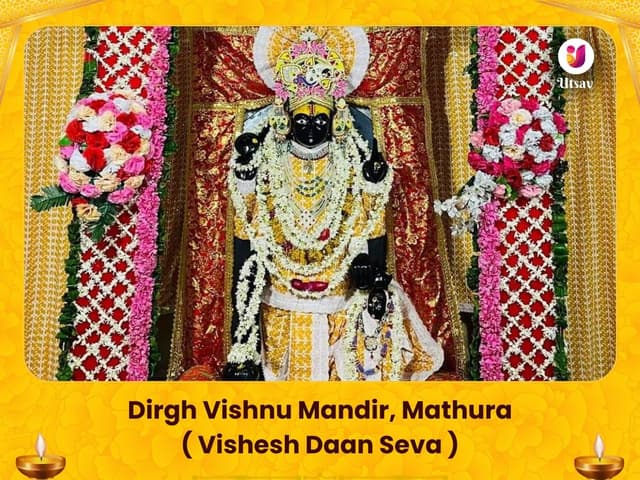

દીર્ઘ વિષ્ણુ મંદિર, મથુરા
ગુરુવાર - 03 ડિસેમ્બર, 2026 - Guruvar Visesh
