Maa Chintpurni Temple: Temple History | Information | Rituals | Online Puja
Maa Chintpurni Temple is a Shaktipeeth dedicated to Goddess Sati. It is dedicated to Mata Bhagwati Chinnamasta Devi and is located in the state of Himachal Pradesh in India.

History:
Chintpurni Temple is dedicated to Mata Chintpurni Devi who is also at times referred to as Mata Chinnamasta. Chinna means ‘without’ and Masta stands for ‘Head’. There is a legend associated with the name. It is stated in the book of Sanatam Dharm, Shri Markandeye Puran, that Mata Bhagwati’s two sahyoginis, named Jaya and Vijaya, defeated many asuras in a fight and drank their blood. However, their thirst was still not quenched so Mata cut off her own head to offer blood to them. Other than that the legend of the temple is the one associated with all the 52 Shaktipeeths in India. Lord Vishnu cut off Maa Sati’s body into 51 pieces to calm down Lord Shiva’s rage.
Out of all the pieces, it is believed that Maa Sati’s head fell here, making it one of the most important Shaktipeeth. Mata Chintpurni Devi is a symbol of self-sacrifice and according to legend, she is protected by Lord Shiva in the four directions. As such, there are four temples surrounding the main temple. Kaleshwar Mahadev is present in the east, Narayhana Mahadev is found in the west, Shiva Bari in the south, and Muchkund Mahadev in the north.
Information:
It is generally believed that the shrine of Mata Chintpurni Devi in Chhaproh village was established by Pandit Mai Das, 12 generations ago. His descendants are still to be found offering their services as official priests at this temple. Maa Chintpurni Temple is very easy to reach. You can travel by rail, where the closest station will be Una Himachal (about 55 KM). You can also travel by air, in which case you need to land at the Chintpurni Temple in Gaggal at Kangra. It is around 70 KM from Chintpuni. Apart from that, there are buses that travel by road. The temple is open to everyone from 4 am to 11 pm.
Architecture:
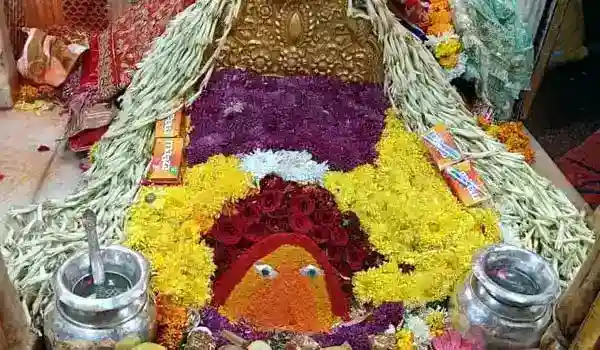
Chintpurni Devi Mandir is a single-storeyed building made with stones. It has an entrance facing the north, before which stands an old Banyan tree. There is a bell hanging at the entrance which devotees toll. One can also find idols of Lord Ganesh and Lord Hanuman inside the temple. The pindi of the mother goddess is in a palanquin of white marble. There are also some engraved images of Bhairon and Hanuman in the western part of the dome. There is also a banyan tree on the temple premises (not the one at the entrance) which is recognized as the place where children get their ‘mundan’ (first haircutting) ceremony.
As stated earlier, the temple is also guarded by Lord Shiva on four sides. The paths to the temple were made by Diwan Dina Nath, who was a nobleman. There is also a tank near the temple where devotees are known to take a holy dip.
Rituals:
The Chintpurni Devi Mandir has the stone idol (pindi) of the Goddess which is worshipped every day by the descendants of Mai Dass. During the fair, devotees offer a very specific set of offerings to the Goddess. It includes seven pieces of betelnut which are commonly known as supari, a red flag (dhawaja), and a piece of coconut (nariyal). These are bound together with a home- spun multi-colored cotton yarn called Mauli. During the eighth day of the fair, offerings of ‘Karah’ (halwa) and ‘chattar’ are also made.
Puja:
Chintpurni Devi Puja follows a strict schedule. Every year the Chintpurni fair, also known as the ‘Mata Da Mela’ takes place thrice in the month of Chet (March-April), Sawan (July-August), and Asanj (September-October). Many devotees visit the temple during these 9 to 10 days and offer their prayers to the mother goddess.