5 Powerful Durga Mantras: Meaning & Benefits
By Pandit Anand S., Vedic Scholar with 15+ years in Shakti traditions | Reviewed by Utsav editorial team
Chanting Durga Mantras connects you directly to the divine feminine energy of Shakti, offering protection, prosperity, and spiritual clarity. These mantras, drawn from sacred texts like the Durga Saptashati, aren't just words; they are sonic forms of the Goddess herself. Over 5 Lakh+ Devotees have participated in Devi pujas through Utsav to align with this powerful energy.
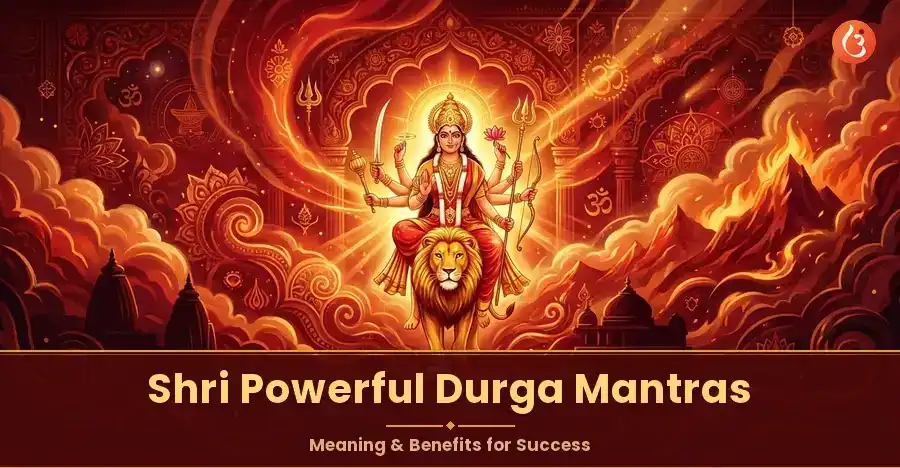
Quick Answer: 5 Essential Durga Mantras
- What: Potent Sanskrit hymns dedicated to Goddess Durga, the universal mother.
- Why: To invoke protection, remove obstacles, and attract auspiciousness and prosperity.
- Key Mantras: Includes the Sarva Mangala Mangalye shloka, the Navarna Mantra, and the Durga Gayatri.
- How to Participate: Connect with verified pandits for powerful Devi Pujas on Utsav, with Dakshina starting from ₹501.
Table of Contents
- 1. Sarva Mangala Mangalye: The Mantra for Auspiciousness
- 2. Ya Devi Sarva Bhuteshu: The Mantra of Omnipresence
- 3. Dehi Saubhagyam Aarogyam: The Mantra for Fortune & Health
- 4. Om Aim Hreem Kleem: The Navarna Mantra
- 5. Durga Gayatri Mantra: For Divine Illumination
- How to Chant Durga Mantras for Maximum Benefit?
- Participate in Powerful Devi Pujas on Utsav
1. Sarva Mangala Mangalye: The Mantra for Auspiciousness
This is arguably one of the most recognized and powerful shlokas dedicated to the Goddess. It's not just a prayer; it's a profound statement of her power. Sourced directly from the Narayani Stuti in the Durga Saptashati (Chapter 11, Verse 10), this mantra is chanted at weddings, festivals, and daily pujas to invoke blessings and good fortune. You've almost certainly heard it before.
Mantra (मंत्र):
सर्वमङ्गलमाङ्गल्ये शिवे सर्वार्थसाधिके ।
शरण्ये त्र्यम्बके गौरि नारायणि नमोऽस्तु ते ॥
English Transliteration:
Sarva Mangala Mangalye, Shive Sarvartha Sadhike |
Sharanye Tryambake Gauri, Narayani Namostute ||
Meaning:
"I bow to you, Narayani, the one who is the source of all auspiciousness, the consort of Shiva, who fulfills all desires. You are the ultimate refuge, the three-eyed Gauri."
Each name used in this mantra is a universe of meaning. Sarva Mangala Mangalye means she is the auspiciousness behind all that is auspicious. Shive refers to her as the benevolent one, the pure energy that is the consort of Shiva. Sarvartha Sadhike identifies her as the one who can accomplish any and all righteous objectives. By calling her Sharanye, we acknowledge her as the ultimate refuge. Tryambake Gauri praises her as the three-eyed, radiant one, whose vision encompasses past, present, and future. Finally, Narayani connects her to the supreme sustaining power of the cosmos.
Why it's so powerful: Chanting this mantra aligns your energy with universal auspiciousness. It's a direct appeal for success in all endeavors and is believed to remove any obstacle that stands in the way of a devotee's righteous goals. It's a complete package.
2. Ya Devi Sarva Bhuteshu: The Mantra of Omnipresence
This mantra is a recurring refrain from the Devi Stuti in the Durga Saptashati (Chapter 5), where the Gods praise the Devi after she vanquishes the demon Mahishasura. It acknowledges her presence in every aspect of creation. Thing is, it’s not just one mantra but a formula that can be adapted to recognize her in countless forms.
Mantra (मंत्र):
या देवी सर्वभूतेषु शक्तिरूपेण संस्थिता ।
नमस्तस्यै नमस्तस्यै नमस्तस्यै नमो नमः ॥
English Transliteration:
Ya Devi Sarva Bhuteshu, Shakti Rupena Samsthita |
Namastasyai Namastasyai Namastasyai Namo Namah ||
Meaning:
"To the Goddess who resides in all beings in the form of power (Shakti), I bow to her again and again."
The Devi Mahatmyam itself provides a powerful list of her manifestations. By chanting this verse while meditating on her different attributes, a devotee acknowledges her presence in every facet of existence:
- Buddhi-rupena: In the form of intellect.
- Nidra-rupena: In the form of sleep.
- Kshudha-rupena: In the form of hunger.
- Chhaya-rupena: In the form of shadow or reflection.
- Shakti-rupena: In the form of energy.
- Trishna-rupena: In the form of thirst or craving.
- Kshanti-rupena: In the form of forgiveness.
- Shraddha-rupena: In the form of faith.
- Lajja-rupena: In the form of modesty.
Why it's so powerful: This mantra cultivates a deep sense of connection to the divine in everything. You can replace "Shakti" (शक्ति) with other forms like "Buddhi" (बुद्धि - intelligence), "Lakshmi" (लक्ष्मी - wealth), or "Kshanti" (क्षान्ति - forgiveness). It’s an incredible tool for shifting your perspective and seeing the divine spark in everyone and everything around you.
3. Dehi Saubhagyam Aarogyam: The Mantra for Fortune & Health
This powerful prayer comes from the Argala Stotram, a preliminary hymn chanted before the main Durga Saptashati. According to tradition, reciting the Argala Stotram unlocks the full benefits of the main text. This specific verse is a direct and heartfelt request for the most essential blessings in life. It's beautifully simple and potent.
Mantra (मंत्र):
देहि सौभाग्यमारोग्यं देहि मे परमं सुखम् ।
रूपं देहि जयं देहि यशो देहि द्विषो जहि ॥
English Transliteration:
Dehi Saubhagyam Aarogyam, Dehi Me Paramam Sukham |
Rupam Dehi Jayam Dehi, Yasho Dehi Dwiszo Jahi ||
Meaning:
"Grant me good fortune and health, grant me the ultimate happiness. Grant me beauty, grant me victory, grant me fame, and destroy my inner and outer enemies."
The prayer for victory (Jayam) and the destruction of enemies (Dwisho Jahi) is profound. The "enemies" are not just external adversaries but also internal ones: the shad-ripus or six enemies of the mind (lust, anger, greed, attachment, pride, and jealousy). By asking the Devi to destroy these, the devotee seeks inner purification, which is the foundation for true and lasting victory and fame (Yasho) in the world. This mantra thus works on both material and spiritual planes simultaneously.
Why it's so powerful: This isn't a subtle mantra; it's a direct appeal for tangible results. It covers all bases of a fulfilling life—health, happiness, success, and protection. Devotees chant this to overcome adversity and to petition the Goddess for a life filled with well-being and victory.
4. Om Aim Hreem Kleem: The Navarna Mantra
The Navarna Mantra is the nine-syllable Beej (seed) mantra of Goddess Durga in her fierce form as Chamunda. This is one of the most potent and protected mantras in the Shakti tradition. As per the Vaikrita Rahasya of the Durga Saptashati, it encapsulates the energies of the three primary goddesses.
Mantra (मंत्र):
ॐ ऐं ह्रीं क्लीं चामुण्डायै विच्चे ॥
English Transliteration:
Om Aim Hreem Kleem Chamundaye Viche ||
Meaning:
This mantra doesn’t have a literal translation but is composed of powerful Beej sounds:
- Aim (ऐं): Represents Mahasaraswati (knowledge and creation).
- Hreem (ह्रीं): Represents Mahalakshmi (sustenance and wealth).
- Kleem (क्लीं): Represents Mahakali (transformation and dissolution of ego).
- Chamundaye Viche (चामुण्डायै विच्चे): Salutations to Chamunda, the slayer of demons Chanda and Munda, who grants liberation.
Because of its immense power, tradition holds that the Navarna Mantra is most effective when received from a qualified Guru through a formal initiation (diksha). This ensures the devotee is prepared to handle the immense spiritual energy the mantra can awaken.
Why it's so powerful: It's considered the sonic essence of the divine mother. Chanting it is believed to activate all three major forms of Shakti within you, providing a shield of protection, attracting resources, and clearing the path to spiritual wisdom. It’s a complete spiritual practice in one line.
5. Durga Gayatri Mantra: For Divine Illumination
Every major deity has a Gayatri mantra, and Durga's is a profound tool for meditation and invoking her protective, guiding light. This mantra, structured in the traditional Vedic Gayatri meter, is used to sharpen the intellect and gain spiritual insight directly from the Goddess.
Mantra (मंत्र):
ॐ गिरिजायै विद्महे, शिवप्रियायै धीमहि, तन्नो दुर्गा प्रचोदयात् ॥
English Transliteration:
Om Girijayai Vidmahe, Shiva Priyayai Dhimahi, Tanno Durga Prachodayat ||
Meaning:
"Om, let us meditate on the daughter of the mountains (Girija), the beloved of Shiva. May that Durga illuminate our minds."
The name Girija literally means "Daughter of the Mountain," referring to her incarnation as Parvati, the daughter of Himavan, the king of the Himalayas. This name evokes stability, strength, and unshakeable resolve. Shiva Priya highlights her role as the beloved consort of Shiva, the inseparable energy (Shakti) that allows consciousness (Shiva) to act. Unlike mantras that petition for specific outcomes, a Gayatri mantra is a request for enlightenment. It asks the deity to "prachodayat"—to impel, inspire, and illuminate our intellect (dhi), clearing away the clouds of ignorance so we may perceive reality clearly.
Why it's so powerful: While other mantras focus on protection and prosperity, the Durga Gayatri is purely for spiritual awakening. It's a prayer for divine guidance. Chanting it helps you connect with your inner wisdom and intuition, allowing the Goddess to guide your thoughts and actions.
How to Chant Durga Mantras for Maximum Benefit?
To truly connect with the energy of these mantras, the method matters. It’s not just about recitation; it’s about intention. As laid out in various Puranic and Tantric texts, a few simple steps can amplify the benefits.
- Create a Sacred Space: Find a quiet, clean corner. Sit facing East or North. You can light a ghee lamp and some incense to purify the atmosphere. A small image or murti of the Goddess can serve as a focal point for your devotion. The external cleanliness reflects and encourages internal purity.
- Set Your Intention (Sankalpa): Before you begin, hold a clear thought about why you are chanting. Is it for protection, clarity, or gratitude? This focuses your energy. This is not a bargain, but a heartfelt dedication of your practice towards a specific, positive outcome for yourself or others.
- Use a Japa Mala: A 108-bead mala (Rudraksha or Sphatik is ideal) helps you keep count and maintain a meditative rhythm. Chant the mantra 108 times for a full cycle. Rudraksha beads are sacred to Shiva and are believed to calm the mind, while Sphatik (crystal) malas are known for their cooling properties and ability to enhance concentration. The 109th bead, or Meru, signifies the supreme consciousness, which one does not cross.
- Focus on Pronunciation: Don't rush. Listen to an authentic recording if you're unsure. The vibrational quality of the sound is what creates the effect. The power of a mantra lies in its sound-vibration (Shabda Brahman). Correct pronunciation ensures that you are creating the intended energetic frequency.
- Consistency is Key: Chanting for 5-10 minutes daily is far more effective than chanting for an hour once a month. The energy builds over time. Think of it like tending a fire. Small, regular additions of fuel keep it burning brightly, whereas infrequent, large efforts may cause it to die out between sessions. You can learn more about the specifics in our detailed Durga Mantra guide.
Participate in Powerful Devi Pujas on Utsav
While personal chanting is powerful, participating in rituals performed by verified pandits can create a profound impact. Group prayer and professionally conducted rituals generate a magnified field of spiritual energy. Utsav connects you with authentic Devi pujas at renowned temples, allowing you to benefit from this collective devotion.
- Sri Kamalatmika Matangi Sanyukt Beej Mantra Jaap & Hawan: A powerful ritual combining the energies of two Mahavidyas for prosperity and wisdom.
- Bonalu Vishesh Maa Chamundeshwari Navchandi & 64 Yogini Homa: Participate in a grand Homa to invoke the blessings of Maa Chamundeshwari and the 64 Yoginis for protection from all negative forces.
When you participate, pandits chant your name and gotra during the Sankalp, personally dedicating the fruits of the puja to you and your family. You receive a video of the puja along with blessed prasad delivered to your home, creating a tangible connection to the sacred ritual.
Scripture Composer/History
The powerful mantras in this guide are primarily drawn from the Durga Saptashati, also known as the Devi Mahatmyam. This sacred text is not attributed to a single human author but is considered a divine revelation (Shruti). It forms chapters 81-93 of the classical Sanskrit scripture, the Markandeya Purana, composed circa 400-600 CE. Within the text, the teachings are revealed by the sage Medhas, as part of a larger narrative by Rishi Markandeya. As a cornerstone of the Shakta tradition, its verses have been meticulously transmitted for centuries through oral recitation (guru-shishya parampara) and manuscript lineages, forming the core of Devi worship, especially during Navaratri.
ॐ जयन्ती मङ्गला काली भद्रकाली कपालिनी ।
दुर्गा क्षमा शिवा धात्री स्वाहा स्वधा नमोऽस्तु ते ॥
Om Jayanti Mangala Kali Bhadrakali Kapalini |
Durga Kshama Shiva Dhatri Swaha Swadha Namostute ||
Sources & References
- Scriptural Authority: The mantras are primarily sourced from the Markandeya Purana, specifically the Durga Saptashati (also known as Devi Mahatmyam), and the associated Argala Stotram.
- Recitation Tradition: The methods of chanting and their benefits are derived from traditional Shakti worship practices and Agamic texts.
- Related Pujas on Utsav: All mentioned pujas are performed by verified temple pandits in partnership with Utsav.