En
En
The Narayan Kavach (नारायण कवच) is a supreme Vedic hymn that acts as a divine shield, offering spiritual protection against all forms of danger. It originates from the Srimad Bhagavatam (Canto 6, Chapter 8), where it's given by Sage Vishwaroop to Indra. This isn't just a prayer; it's an armour of divine energy. Over 5 Lakh devotees deepen their connection to Lord Vishnu through pujas on Utsav.
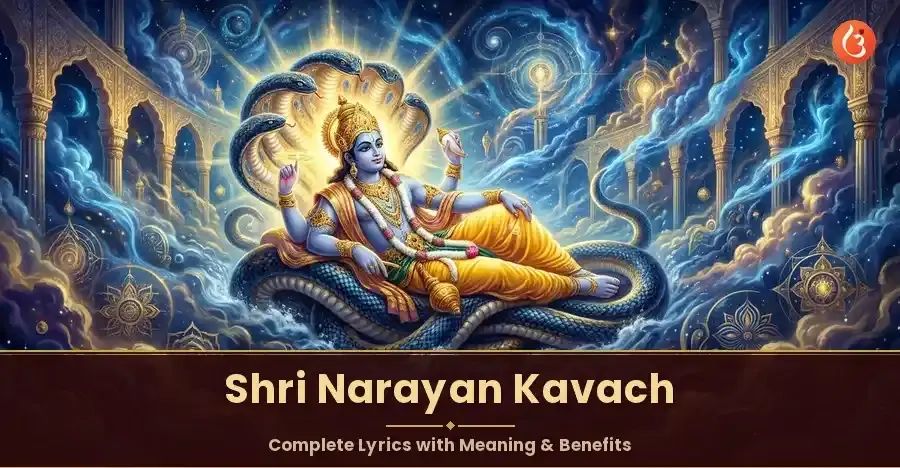
The Narayan Kavach is far more than a simple stotra. As described in the Srimad Bhagavatam (श्रीमद्भागवतम्), it's a systematic invocation of Lord Vishnu's various forms, names, and weapons, each tasked with protecting a specific part of the body and soul. Think of it as consecrating your entire being with divine energy. Its power doesn't come from mere recitation but from the sincere faith that you are placing yourself under the direct care of Lord Narayan.
The hymn's potency lies in its structure. It begins with nyasa - the spiritual act of placing the divine onto one's own body. Each verse then calls upon a specific avatar or aspect of Vishnu, like Matsya to protect from aquatic dangers or Narasimha to guard against predators and enemies. The Sudarshana Chakra is invoked to burn away negativity, the Kaumodaki mace to smash obstacles, and the Panchajanya conch to dispel fear with its divine sound. This transforms the chanter's body into a fortress of divine presence.
Why does this matter so much? In Vedic tradition, a "Kavach" is literally an armour. While a warrior wears physical armour, a devotee wears spiritual armour. This hymn is designed to protect you from dangers you can see and, more importantly, from those you can't - like negative planetary influences, unseen entities, and internal fears. It's a declaration of surrender to the ultimate protector. The mantra shakti (power of the sacred syllables) combined with the devotee's bhakti (devotion) creates an energy field that is impenetrable to harm.
The origin of the Narayan Kavach, according to the Puranic narrative, is a story of desperation and divine intervention. The gods, led by Indra, were once defeated and driven out of their celestial abode by the powerful asura (demon) Vritrasura. Demoralised and helpless, Indra sought the guidance of the sage Vishwaroop. It was Vishwaroop who bestowed this sacred Kavach upon him.
The context of this conflict is crucial. Vritrasura was not an ordinary demon; he was born from the sacrificial fire of the sage Tvashta, who sought revenge against Indra for killing his son, Trishira. Vritrasura was the very embodiment of Tvashta's wrath and was fortified with immense power. He had expanded his form to cover all the worlds, and the devas, stripped of their divine lustre (tejas), fled in terror. They were not just militarily defeated; they were psychologically broken.
It was in this moment of utter hopelessness that Indra approached Vishwaroop. Interestingly, Vishwaroop was also a son of Tvashta, making him Vritrasura's brother. Yet, as the preceptor of the gods, his duty was to guide Indra. He didn't just give Indra a mantra; he gave him a divine weapon system. By chanting the Narayan Kavach with unwavering faith, Indra was enveloped in a protective shield that made him invincible. This divine armour gave him the spiritual strength and confidence to face Vritrasura and ultimately reclaim the heavens. This story highlights a key point: the Kavach is most effective when you're facing overwhelming odds and need a source of ultimate, unshakable power. It’s a tool for the spiritual warrior.
Devotees who chant the Narayan Kavach regularly report a wide range of benefits that span the spiritual, mental, and physical realms. The Phala Shruti (the concluding verses describing the fruits of recitation) of the Kavach itself promises comprehensive protection. Here’s what you can seek.
Spiritual & Astrological Benefits:
| Vishnu's Form Invoked | Protection From |
|---|---|
| Lord Narasimha | Enemies, wild animals, and battlefield dangers. |
| Lord Varaha | Dangers from water and on land. |
| Lord Vamana | Falling from high places or celestial dangers. |
| Lord Hayagriva | Heresy, disrespect to scriptures, and intellectual arrogance. |
| Lord Garuda | All kinds of serpents and poisons. |
Mental & Practical Benefits:
To experience the full power of the Narayan Kavach, it should be chanted with proper procedure and devotion. It's not about rushing through the words; it's about feeling the presence of the Lord. The method prescribed in the Srimad Bhagavatam is specific.
When to Chant for Maximum Efficacy
For best results, it's recommended to chant it daily, especially in the morning during Brahma Muhurta (roughly 90 minutes before sunrise). Other auspicious times include the sandhya kalas (sunrise and sunset) or before embarking on any important task, journey, or competition.
A Simplified Vidhi for Beginners
If the full procedure seems daunting, do not be discouraged. Lord Vishnu values devotion (bhakti) above all else. A simplified practice can be followed:
Consistency and faith are more important than rigid, complex rituals when you are starting your spiritual journey.
Chanting the Narayan Kavach is a personal practice, but you can deepen your connection to Lord Vishnu by participating in authentic temple rituals. While personal chanting builds your individual shield, a temple puja amplifies this energy through the power of collective sankalpa and the sanctified vibrations of the temple space (kshetra shakti). Verified pandits on Utsav perform pujas that align with these powerful Vedic traditions.
Recommended Pujas for Devotees of Lord Vishnu:
When you Participate, you'll fill out a Sankalp Form with your name and gotra. The pandit performs the puja on your behalf, and you receive a video of the ritual and authentic temple prasad delivered to your home.
The Narayan Kavach is not a standalone text but an integral part of the Srimad Bhagavatam (Bhagavata Purana), one of the eighteen Mahapuranas. Its authorship is canonically attributed to the revered sage Veda Vyasa. While tradition places Vyasa in the Dvapara Yuga, modern scholarship dates the Bhagavatam's final compilation to the early medieval period (c. 8th-10th century CE). Composed in classical Sanskrit, this powerful hymn is located in the 8th chapter of the 6th Canto. As a core element of a foundational Vaishnava scripture, its transmission has been meticulously preserved through the Guru-Shishya parampara (master-disciple lineage). For centuries, devotees have passed it down through oral recitation and manuscript traditions, safeguarding its sacred power.
Scriptural Authority:
* Srimad Bhagavatam, Canto 6, Chapter 8 - The original source text for the Narayan Kavach, detailing the conversation between Sage Vishwaroop and Indra.
Temple Verification:
* The puja vidhi and benefits described are aligned with the practices of Vaishnava temples partnered with Utsav, such as the Deergh Vishnu Mandir in Mathura.
Panchang & Dates:
* All auspicious timings and festival dates referenced are based on the Vedic Panchang, which you can check on the Utsav Panchang.
Related Pujas on Utsav:

Rahu Paithani Temple, Paithani
Sat - Nov 28, 2026 - Shanivar Visesh