Dashrath Krit Shani Stotra: Lyrics, Meaning & Powerful Benefits
By Pandit Vikram Joshi, Jyotish & Vedic Ritual Specialist | Reviewed by Utsav editorial team
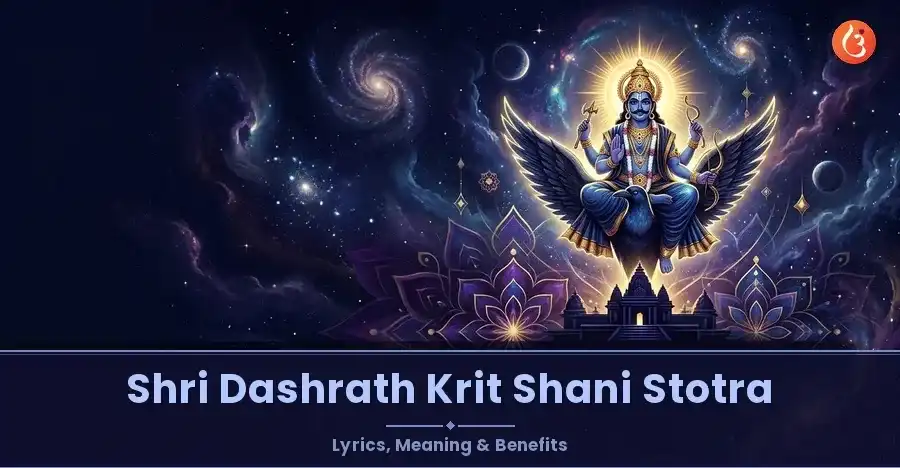
The Dashrath Krit Shani Stotra (दशरथ कृत शनि स्तोत्र) is a powerful Sanskrit hymn composed by King Dasharatha to appease Shani Dev. Its origin is documented in the Padma Purana, making it one of the most authentic Vedic remedies against the malefic effects of Saturn, especially during Sade Sati. Devotees recite this stotra to gain Shani's blessings, remove obstacles, and navigate challenging astrological periods with protection.
Quick Answer: Dashrath Shani Stotra Facts
- What: A sacred hymn of 11 verses composed by King Dasharatha to praise and pacify Lord Shani.
- Why: Chanted to mitigate the hardships of Sade Sati, Shani Dhaiyya, and other Saturn-related afflictions in one's horoscope.
- Source: Its complete legend and text are found in the ancient Hindu scripture, the Padma Purana.
- How to Participate: You can complement your chanting by booking a Saturday Special Shani Graha Shanti Seva with Utsav's verified pandits.
Table of Contents
- The Legend: Why Did King Dasharatha Create this Stotra?
- Dashrath Krit Shani Stotra: Complete Lyrics in English
- Verse-by-Verse Meaning of the Shani Stotra
- What are the Benefits of Chanting this Stotra?
- How to Recite the Stotra: The Complete Vidhi
- Who Should Chant the Dashrath Shani Stotram?
- Participate in Shani Graha Shanti Puja on Utsav
- Sources & References
The Legend: Why Did King Dasharatha Create this Stotra?
The story behind this stotra, as narrated in the Padma Purana, is a testament to a king's love for his people. It's not just a random collection of verses; it's a prayer born from courage. When astrologers informed King Dasharatha that Shani Dev was about to enter the Rohini Nakshatra, they warned him of a catastrophic 12-year famine that would devastate his kingdom.
Unwilling to watch his subjects suffer, Dasharatha did the unthinkable. He flew his divine chariot beyond the realm of mortals and into the planetary orbits to confront Shani Dev directly. That's a serious move. Impressed by the king's bravery and unwavering commitment to his dharma, Shani Dev granted him a boon. Dasharatha simply asked him to spare his kingdom. Pleased, Shani not only agreed but also taught him this powerful stotra, promising that anyone who recites it with devotion will never suffer from his harshest effects.
नम: कृष्णाय नीलाय शितिकण्ठ निभाय च।
नम: कालाग्निरूपाय कृतान्ताय च वै नम: ॥१॥
Namaḥ kṛṣṇāya nīlāya śitikaṇṭha nibhāya ca|
Namaḥ kālāgnirūpāya kṛtāntāya ca vai namaḥ ||1||
Dashrath Krit Shani Stotra: Complete Lyrics in English
Here is the complete text of the stotra in Roman transliteration for easy recitation. As our verified pandits always advise, focus on clear pronunciation to connect with the hymn's vibrational energy.
Invocation
Om. Asya Shri Shani Stotra Mantrasya Dasharatha Rishi, Shanidevata, Trishtup Chandah, Shri Shani prityarthe jape viniyogah.
Dasharatha Uvacha (Dasharatha Said)
Kona-stha pingalo vabhruh krishno roudran-tako yamah |
Sourih shanaish-charo mandah pippaladena sansthitah ||
Main Stotra
Namah krishnaya neelaya shiti-kantha-nibhaya cha |
Namah kalagni-rupaya kritantaya cha vai namah || 1 ||
Namo nirmansa-dehaya deergha-shamshru-jataya cha |
Namo vishala-netraya shushkodara bhayakrite || 2 ||
Namah pushkala-gatraya sthula-romne tathaiva cha |
Namo deerghaya shushkaya kala-danshtra namostute || 3 ||
Namaste kotarakshaya durnireekshyaya vai namah |
Namo ghoraya raudraya bheeshanaya karaline || 4 ||
Namaste sarva-bhakshaya valee-mukha namostute |
Surya-putra namaste ‘stu bhaskare bhaya-dayine || 5 ||
Adho-drishte namaste ‘stu sanvartaka namostute |
Namo mandagate tubhyam nih-trimsaya namostute || 6 ||
Tapasa dagdha-dehaya nityam yoga-rataya cha |
Namo nityam kshudhartaya atriptaya cha vai namah || 7 ||
Gyanam-chakshur namaste ‘stu kashyap-atmaja-sunave |
Tushto dadasi vai rajyam rushto harasi tat-kshanat || 8 ||
Devasura-manushyash-cha siddha-vidyadharo-ragah |
Tvaya vilokitah sarve nasham yanti samulatah || 9 ||
Prasadam kuru me deva vararho ‘ham upagatah |
Evam stutastada sourir-griraho-raja mahabalah || 10 ||
Phala Shruti (Verse of Benefits)
Prasannam vadanam kritva vahanastham tatho ‘bravit |
Tushto ‘ham tava rajendra stotre-nanena suvrata || 11 ||
Verse-by-Verse Meaning of the Shani Stotra
Understanding the meaning deepens your connection to the prayer. It's one thing to chant, but it's another to know what you're truly asking for. The meanings here are based on traditional interpretations from our consulting acharyas.
- Verse 1: I bow to you, who are dark and blue like the throat of Shiva. I bow to you, who are the fire of time and the embodiment of death (the ender).
- Verse 2: Salutations to you, who have a fleshless body, a long beard, and matted hair. I bow to you, with your large eyes, hollow stomach, and fearsome form.
- Verse 3: I bow to your well-built body and thick hair. Salutations to your tall, lean form and your teeth as sharp as time. You feel it's intense, right? That's his power.
- Verse 4: Salutations to your deep-set eyes, which are difficult to look upon. I bow to you, who are terrifying, fierce, dreadful, and formidable.
- Verse 5: I bow to you, the consumer of all. Salutations, O powerful one! Salutations to you, son of the Sun God, who is radiant and inspires fear.
- Verse 6: Salutations to you of the downward gaze, O dissolver of the universe. I bow to your slow pace and to you who are merciless in judgment.
- Verse 7: I bow to you whose body is refined by penance and who is always absorbed in yoga. Salutations to you who are ever hungry yet never satisfied (symbolizing endless karmic consumption).
- Verse 8: Salutations to your eye of wisdom, O son of Kashyapa. When pleased, you grant a kingdom, and when angered, you take it away in an instant. (This is the key to his nature).
- Verse 9: Gods, demons, humans, siddhas, vidyadharas, and nagas—all who are glanced upon by you are destroyed from their very roots.
- Verse 10: O Lord, be pleased with me, for I have come to you seeking your grace. Thus praised, the powerful king of planets, the son of the Sun, was moved.
- Verse 11: With a pleased expression, he, seated on his mount, said, "O great King, I am pleased with this powerful prayer of yours."
What are the Benefits of Chanting this Stotra?
Reciting this stotra isn't just about avoiding trouble; it's about aligning yourself with the cosmic principle of karma and discipline that Shani Dev represents. According to Jyotish experts, consistent chanting brings profound changes.
- Protection During Sade Sati: This is its primary benefit. The stotra acts as a kavach (shield), reducing the mental anguish, financial loss, and health issues associated with the 7.5-year transit.
- Relief from Shani Dhaiyya & Ashtama Shani: It also provides significant relief during other challenging Saturn periods.
- Removes Obstacles: It helps clear delays and blockages in career, business, and personal life. Things just start moving again.
- Instills Discipline & Patience: Shani rewards hard work and patience. Chanting this stotram helps you develop these virtues, aligning you with cosmic law and ensuring long-term success.
- Reduces Fear and Anxiety: By placing your faith in the ultimate judge of karma, you reduce the fear of the unknown. You learn to accept and act, not just react.
- Grants Shani's Blessings: When pleased, Shani can bestow immense power, authority, and success. This stotra is the key to earning his favor.
How to Recite the Stotra: The Complete Vidhi
For any mantra or stotra to be effective, following the correct procedure (vidhi) is essential. Our temple pandits recommend this simple yet powerful method.
- Best Day: Saturday is the most auspicious day to start and perform the recitation.
- Time: The ideal time is in the evening, after sunset, during the Pradosh Kaal.
- Preparation: Take a bath, wear clean, dark-colored clothes (blue or black is preferred), and sit on a clean asana facing west.
- Setup: Place an image or idol of Shani Dev or Hanuman Ji before you. Light a lamp (diya) with mustard oil or sesame (til) oil.
- Sankalp (Intention): Take a little water in your right palm and state your name, gotra, and your wish for reciting the stotra (e.g., for relief from Sade Sati). Let the water flow to the ground.
- Recitation: Chant the stotra with a clear, steady voice. You can recite it 1, 3, or 11 times, depending on your capacity. For severe afflictions, 11 repetitions are recommended.
- Closing: After the recitation, offer your prayers and meditate on Shani Dev's form. You can also offer blue flowers or black sesame seeds.
Who Should Chant the Dashrath Shani Stotram?
While anyone can chant this stotra for discipline and focus, it's especially recommended for individuals facing specific astrological challenges. You should seriously consider making this a regular practice if you're undergoing:
- Sade Sati: The seven-and-a-half-year period when Saturn transits over the 12th, 1st, and 2nd houses from your natal Moon.
- Shani Dhaiyya (Kantaka/Ashtama): The two-and-a-half-year period when Saturn transits the 4th or 8th house from your natal Moon.
- Shani Mahadasha or Antardasha: If you are running the major or sub-period of Saturn in your Vimshottari Dasha cycle.
- Afflicted Saturn in Birth Chart: If Saturn is weak, debilitated, conjunct with malefic planets, or in a challenging position in your horoscope, this stotra can provide immense strength.
You can learn more about how Saturn's movements impact your life by reading our guide on Saturn Transit in Revati Nakshatra.
Participate in Shani Graha Shanti Puja on Utsav
For devotees seeking a deeper connection and ritualistic support, complementing your personal chanting with a professionally performed puja can be life-changing. Utsav connects you with verified pandits at renowned temples who perform these rituals on your behalf.
Recommended Pujas for Shani Shanti:
- Saturday Special Shani Graha Shanti Weekly Oil & Till Daan Seva: A powerful weekly service to consistently appease Shani Dev. Dakshina starts from ₹251.
- 23,000 Shani Mool Mantra Jaap & Tel Abhishek: An intensive puja for tackling more severe astrological challenges.
How to Participate:
1. Select your preferred puja and Dakshina.
2. Fill out the Sankalp Form with your name and gotra.
3. The pandit performs the puja, chanting your details.
4. You receive a video of the puja via WhatsApp within 3-5 days.
Scripture Composer/History
The Dashrath Krit Shani Stotra was composed by its namesake, King Dasharatha of Ayodhya, the father of Lord Rama from the Ikshvaku dynasty. Its origin is placed in the Treta Yuga of Hindu cosmology. The definitive scriptural source for this hymn is the Padma Purana, which contains the complete narrative of Dasharatha's encounter with Shani Dev and the subsequent composition of this prayer.
Composed in classical Sanskrit, the stotra's language is direct and reverential, typical of the Puranic literary tradition. It has been preserved and transmitted for millennia through this lineage. Devotees and Jyotish acharyas consider it one of the most authentic and powerful Vedic remedies, passed down through generations as a sacred tool to seek protection from Saturn's malefic influence.
Sources & References
Scriptural Authority:
- Padma Purana: The primary ancient text that documents the legend of King Dasharatha and contains the original Sanskrit verses of this stotram.
Astrological & Ritual Tradition:
- Brihat Parashara Hora Shastra: Foundational text of Vedic astrology that explains the nature and effects of Shani.
- Temple Traditions of Ujjain: The recitation vidhi is verified against practices at the Navgraha Shani Mandir in Ujjain.
Related Pujas on Utsav:
- Saturday Special Shani Graha Shanti Seva
- Shani Mool Mantra Jaap & Tel Abhishek