"Navagraha Stotra Guide : Lyrics, Meaning & Planetary Benefits"
By Pandit Anand S., Vedic Scholar with 15+ years in Jyotish & temple traditions | Reviewed by Utsav editorial team
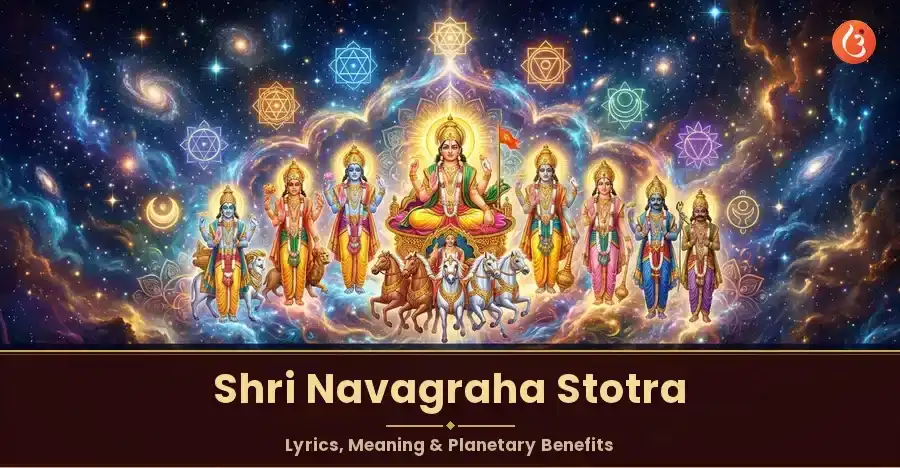
The Navagraha Stotra (नवग्रह स्तोत्र) is one of Vedic astrology's most essential hymns for balancing planetary energies in a devotee's life. Attributed to the great sage Maharishi Vyasa, this stotra contains nine powerful verses, each dedicated to one of the nine celestial bodies (Grahas) that influence our karmic journey. It's not just a prayer; it's a tool for cosmic harmony. Over 5 Lakh devotees have sought planetary remedies through Utsav's verified temple pujas.
Quick Answer: Navagraha Stotra
- What: A nine-verse Sanskrit hymn to appease the nine planets (Sun, Moon, Mars, Mercury, Jupiter, Venus, Saturn, Rahu, Ketu).
- Why: Chanted to mitigate negative planetary influences (doshas), reduce obstacles, and enhance positive energies for health, wealth, and peace.
- Who Wrote It: Traditionally attributed to Maharishi Vyasa, the revered sage who also compiled the Mahabharata.
- How to Participate: You can Participate in a Navagraha Shanti Puja at verified temples with Dakshina from ₹501.
Table of Contents
- Who Composed the Navagraha Stotra?
- Navagraha Stotra: Complete Text in English
- Verse-by-Verse Meaning of the Navagraha Stotra
- What Are the Benefits of Chanting This Stotra?
- How to Chant the Navagraha Stotra (Complete Vidhi)
- Participate in Graha Shanti Pujas on Utsav
- Sources & References
Who Composed the Navagraha Stotra?
The composition of the Navagraha Stotra is traditionally credited to Maharishi Vyasa (महर्षि व्यास), one of the most revered sages in Hindu tradition. Known as Veda Vyasa, he is the monumental figure who classified the single primordial Veda into four parts—Rigveda, Yajurveda, Samaveda, and Atharvaveda. He is also the author of the epic Mahabharata, the Puranas, and the Brahma Sutras. According to Puranic literature, Vyasa is an immortal (Chiranjivi) who lives through the ages to ensure the preservation of Vedic knowledge. His authorship gives this stotra immense authority and spiritual weight, placing it in the same league as other foundational scriptures.
This isn't just some random text. It's a precisely engineered set of vibrations (mantras) designed to align a devotee's consciousness with the cosmic frequencies of the planets. In Vedic thought, sound (Shabda) is a creative force. The specific epithets and descriptions in each verse are drawn from the deepest layers of Jyotish (Vedic astrology) to invoke the unique energy of that Graha. Think of it as a spiritual tuning fork for your soul; by chanting these verses, you are recalibrating your own energy field to resonate harmoniously with the celestial bodies, rather than being disrupted by them.
Navagraha Stotra: Complete Text in English
Here is the complete text of the Navagraha Stotra for recitation. It's structured with one verse for each of the nine planets.
ॐ श्री गणेशाय नमः ।
Om Shri Ganeshaya Namah
Verse 1: Surya (Sun)
Japaa kusuma Sankaasam - Kaasyapeyam Mahaath'yuthim
Thamo'urim sarva paapa ganam - Pranathosmi Divaakaram
Verse 2: Chandra (Moon)
Dhathi sanka thushaaraabam - Ksheero Dhaarnava Sambhavam
Namaami sasinam Somam - Sambhor makuta bhooshanam
Verse 3: Mangal (Mars)
Dharanee garbha sambhootham - Vidhyuth kaanthi sama prabham
Kumaaram sakthi hasthancha - Mangalam pranamaam Yaham
Verse 4: Budha (Mercury)
Priyangu kalikaa syaamam - Roope'naa prathimam Budham
Sowmyam sowmya guno'petham - tham Budham pranamaam Yaham
Verse 5: Guru (Jupiter)
Dhe'vaanaancha Risheenaancha - Gurum kaanchana sannibham
Bhudhdhi bhootham Thrilokesam - tham namaami Brihaspathim
Verse 6: Shukra (Venus)
Hima kundha mrinaa laabam - Dhaithyaanam paramam Gurum
Sarva saasthra pravruththaaram - Bhaargavam pranamaam Yaham
Verse 7: Shani (Saturn)
Neelaanchana samaabaasam - Ravi puthram Yamaagrajam
Chaayaa maarthaanda sambhootham - tham namaami Sanaischaram
Verse 8: Rahu
Ardha kaayam mahaa veeryam - Chandhraadhithya vimardhanam
Simhikaa garbha sambhootham - tham Raahum pranamaam Yaham
Verse 9: Ketu
Palaasa pushpa sankaasam - thaarakaa graha masthakam
Rowdhram rowdhraathmakam go'ram - tham Kethum pranamaam Yaham
Verse-by-Verse Meaning of the Navagraha Stotra
Understanding the meaning behind these powerful verses makes your chanting even more effective. Each Graha is not just a physical body but a divine personality with a specific cosmic function. Here’s what you are invoking for each planet, based on translations by Vedic scholars.
1. Surya (Sun): "I bow to the Sun, who is brilliant as the hibiscus flower, the son of Kashyapa, radiant and the enemy of darkness. He is the destroyer of all sins." The Sun governs your soul (Atma), vitality, ego, leadership qualities, and your relationship with your father.
2. Chandra (Moon): "I bow to the Moon, who is white as curd and a conch shell, born from the churning of the milk ocean. He adorns the crown of Lord Shiva." The Moon controls your mind (Manas), emotions, mother, nurturing instincts, and public life.
3. Mangal (Mars): "I bow to Mars, born of the Earth, who shines with the brilliance of lightning. He is a young man, carrying a spear." Mars represents your energy, courage, ambition, siblings, and logic. A powerful prayer for this planet can be supported by a Mangal Daan Seva.
4. Budha (Mercury): "I bow to Mercury, who is dark as a bud of the Priyangu herb, of unequalled beauty. He is gentle and possesses all pleasing qualities." Mercury governs your intellect (Buddhi), communication, learning, business, and nervous system.
5. Guru (Jupiter): "I bow to Jupiter, the preceptor of gods and sages, who shines like gold. He is the embodiment of intelligence and rules the three worlds." Jupiter represents wisdom, fortune, higher knowledge, teachers (gurus), and children.
6. Shukra (Venus): "I bow to Venus, who is fair as a jasmine flower and the supreme Guru of the demons. He is the master of all scriptures." Venus controls your relationships, luxury, beauty, creativity, and sensual pleasures.
7. Shani (Saturn): "I bow to Saturn, the slow-moving one, who is dark blue in color. He is the elder brother of Yama and the son of the Sun and Chhaya." Saturn is the dispenser of karma, teaching discipline, responsibility, and longevity. To appease him, you can Participate in a Shani Shanti Puja.
8. Rahu: "I bow to Rahu, who has half a body and is of great valor. He torments the Sun and Moon and was born from the womb of Simhika." Rahu governs ambition, worldly desires, sudden events, foreign influences, and technology.
9. Ketu: "I bow to Ketu, who resembles the Palasa flower and is the head of the stars. He is fierce, terrible, and terrifying." Ketu represents spiritual liberation (Moksha), intuition, detachment, and past karmas. For both nodes, a Rahu-Ketu Shani Puja is highly effective.
What Are the Benefits of Chanting This Stotra?
According to Jyotish experts, regular and devout chanting of the Navagraha Stotra offers profound benefits. It's a foundational practice for anyone looking to navigate life's challenges with grace.
- Mitigates Malefic Effects: It's the primary benefit. The stotra helps pacify planets that are weakly placed or afflicted in your birth chart, reducing their negative impact (doshas). This is especially recommended for those experiencing difficult planetary periods (dashas) or transits like Shani's Sade Sati, Mangal Dosha (Kuja Dosha), or afflictions from Rahu and Ketu.
- Strengthens Positive Planets: It doesn't just reduce the bad; it amplifies the good. Chanting enhances the positive effects of well-placed planets (benefics). For example, if Jupiter is strong in your chart, reciting its verse can further boost wisdom, prosperity, and fortunate opportunities.
- Improves Health and Vitality: In Vedic astrology, each planet governs specific parts of the body and potential ailments. The Sun rules the bones, Mars the blood, and Saturn the nervous system. By balancing these planetary energies, the stotra acts as a form of spiritual healing, promoting physical health and resilience.
- Removes Obstacles: By harmonizing planetary energies, the stotra helps clear blockages in your career, relationships, and health. Things just start to flow better, as if cosmic friction has been reduced.
- Promotes Mental Peace: The vibrations of the mantras have a calming effect on the mind, reducing the anxiety, confusion, and emotional turmoil often caused by planetary transits. It acts as a spiritual shield against mental distress.
- Improves Overall Well-being: A balanced astrological chart leads to a balanced life. Devotees often report improvements in health, wealth, relationships, and overall happiness, feeling more aligned with their life's purpose.
How to Chant the Navagraha Stotra (Complete Vidhi)
To get the maximum benefit, Jyotish pandits recommend following a simple procedure (vidhi). It’s not complicated, but discipline and sincerity (shraddha) are key.
- Preparation: Begin with a bath (or at least washing hands, feet, and face) and wear clean clothes. Physical cleanliness promotes mental clarity. It's best to chant on an empty stomach or after consuming only light, sattvic food.
- Timing: The most auspicious time is during the Brahma Muhurta (the 96-minute period before sunrise). During this time, the atmosphere is pure and sattvic, and the mind is most receptive to spiritual vibrations. If that's not possible, chanting after sunrise is also powerful.
- Setup: Sit facing East on a clean asana (mat). You can place a picture or yantra of the Navagrahas in front of you and light a ghee or sesame oil lamp. Offering specific flowers can enhance the connection: red for Sun and Mars, white for Moon and Venus, yellow for Jupiter, blue/black for Saturn, and mixed colors for the others.
- Invocation: Start by chanting "Om Ganeshaya Namah" three times to remove any obstacles from the practice. You can also offer a short prayer to your Guru or Ishta Devata (personal deity).
- Recitation: Chant the entire Navagraha Stotra with clear pronunciation and devotion. Focus on the meaning of each verse as you recite it. For general well-being, one recitation daily is sufficient. For specific issues, pandits may recommend chanting it 9 or 11 times.
- Closing: After completing the recitation, sit quietly for a few minutes in meditation, feeling the vibrations of the mantras. Offer your prayers to the nine planets and ask for their grace and guidance.
- Consistency: Regular practice yields the best results. A consistent daily recitation, even just once, is far more potent than chanting many times sporadically. Make it a part of your daily spiritual routine (Nitya Karma).
Participate in Graha Shanti Pujas on Utsav
While personal recitation of the Navagraha Stotra is powerful, performing a formal Graha Shanti Puja can amplify its effects. Verified pandits at sacred temples can perform these rituals on your behalf.
Recommended Pujas for Planetary Harmony:
- **Navagraha Shanti Puja: