Varaha Jayanti 2026: Date, Story & Puja Vidhi to Honor Vishnu's Boar Avatar
By Pandit Pramod Joshi, Vaishnava Tradition Specialist | Reviewed by Utsav editorial team
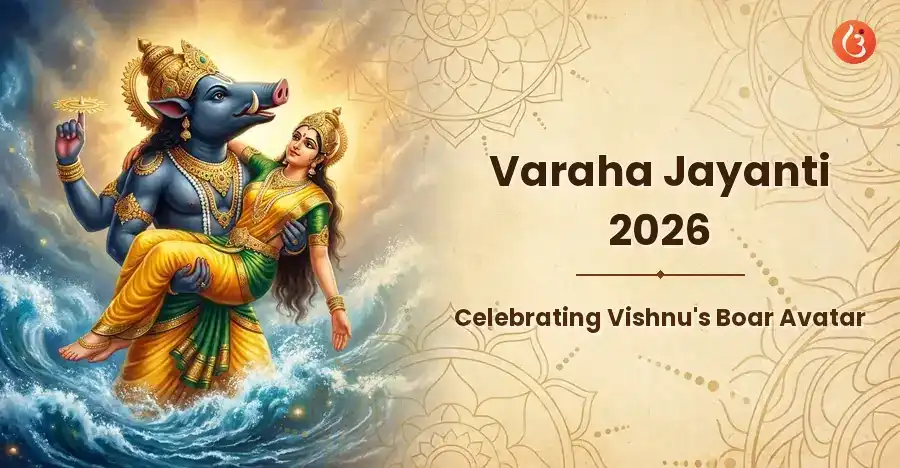
Varaha Jayanti 2026 falls on Sunday, September 13. This powerful day celebrates the third incarnation of Lord Vishnu, who took the form of a divine boar (Varaha) to rescue Goddess Earth (Bhudevi) from the depths of the cosmic ocean. According to the Vishnu Purana, observing this day restores dharma, removes obstacles, and reinforces divine protection in a devotee's life.
TL;DR: Varaha Jayanti celebrates the birth of Vishnu's third avatar, Varaha (वराह). It's observed on Sunday, September 13, 2026, marking the rescue of Goddess Earth (Bhudevi) from the demon Hiranyaksha. The core practice involves fasting and puja to invoke Vishnu's protective energy. You can honor this day by Participating in a Vishnu Sahasranama Puja through Utsav.
Table of Contents
- Varaha Jayanti 2026: Date, Tithi & Shubh Muhurat
- Why Lord Varaha's Avatar Was Essential
- The Legend: How Vishnu Rescued Bhudevi from Hiranyaksha
- Varaha Jayanti Puja Vidhi: A Step-by-Step Guide
- Puja Samagri Checklist
- Key Mantras for Varaha Jayanti
- Fasting Rules for Varaha Jayanti
- Do's and Don'ts on This Sacred Day
- Participate in Vishnu Pujas Through Utsav
- Sources & References
Varaha Jayanti 2026: Date, Tithi & Shubh Muhurat
The timing for Varaha Jayanti is determined by the Bhadrapada Shukla Tritiya tithi, as documented in various Panchangs. For 2026, the key timings are critical for performing the puja correctly. You don't want to miss the most auspicious window.
- Date: Sunday, September 13, 2026
- Tritiya Tithi Begins: 07:08 AM on Sep 13, 2026
- Tritiya Tithi Ends: 07:06 AM on Sep 14, 2026
The Madhyahna (mid-day) period on September 13th is considered the most powerful time for the main puja. Here's a breakdown for major cities:
City | Puja Muhurat Start | Puja Muhurat End |
|---|---|---|
Delhi | 11:02 AM | 01:30 PM |
Mumbai | 11:19 AM | 01:45 PM |
Varanasi | 10:32 AM | 01:01 PM |
Chennai | 10:49 AM | 01:13 PM |
Kolkata | 10:18 AM | 12:48 PM |
Why Lord Varaha's Avatar Was Essential
The Bhagavata Purana (Canto 3) explains that this wasn't just any intervention; it was a cosmic reset. The demon Hiranyaksha had plunged the Earth into the Garbhodaka Ocean, creating chaos and disrupting cosmic order. Why does this ancient story matter so much to you today?
Because Lord Varaha represents the ultimate divine power that lifts you out of your darkest moments. It's a powerful reminder that no matter how deep the crisis (be it financial, emotional, or spiritual), there is a divine force capable of restoring balance. This day is about celebrating that protective energy. It's a promise of restoration.
The Legend: How Vishnu Rescued Bhudevi from Hiranyaksha
The story of Varaha, detailed in the Vishnu Purana, is one of the most dramatic rescue missions in Vedic lore. Hiranyaksha, a powerful asura, had gained a boon from Brahma that made him nearly invincible. Drunk on power, he stole Goddess Earth (Bhudevi) and hid her in the primordial waters. The universe plunged into darkness. The real deal.
Responding to the prayers of the Devas, Lord Vishnu emerged from Brahma's nostril, initially as a tiny boar, and then expanded to a colossal size. He dove into the cosmic ocean, located Bhudevi, and fought a fierce battle with Hiranyaksha that lasted for a thousand years. Finally, Varaha slew the demon and lifted Bhudevi from the depths on His mighty tusks, carefully placing her back in her rightful orbit. This act didn't just save the world; it re-established dharma itself.
Varaha Jayanti Puja Vidhi: A Step-by-Step Guide
Performing the puja at home is straightforward if you follow the correct steps, as prescribed by Vaidik pandits. The goal is to create a sacred space and invite Lord Varaha's energy. Here's how you can do it.
- Purification: Wake up before sunrise, take a bath, and wear clean, fresh clothes. Clean the puja area and sprinkle it with Ganga jal (holy water).
- Sthapana (Installation): Place an idol or image of Lord Varaha on a clean cloth. If you don't have one, an image of Lord Vishnu is perfectly fine.
- Sankalp (Intention): Light a ghee lamp. Hold water in your palm and state your name, gotra, and your prayerful intention for performing the puja.
- Invocation: Chant the Varaha Mool Mantra (see below) to invoke the deity's presence.
- Offerings: Offer fresh flowers (yellow flowers are preferred), fruits, tulsi leaves, and a coconut.
- Scripture Reading: Read or listen to the Varaha Katha from the Puranas. Chanting the Vishnu Sahasranama is also highly auspicious.
- Aarti: Conclude the puja by performing the aarti of Lord Vishnu.
- Prasad: Distribute the offered food as prasad to your family members.
Puja Samagri Checklist
Here’s a simple checklist of items you’ll need. Having everything ready beforehand makes the ritual smooth and focused.
Category | Item | Purpose |
|---|---|---|
Puja Items | Idol/Image of Varaha | The focus of devotion |
Sacred Water | Ganga Jal | For purification of self and space |
Offerings | Yellow flowers, Tulsi | Adornment and respect to Lord Vishnu |
Naivedya | Fruits, sweets, coconut | Blessed food offering |
Lamps & Incense | Ghee diya, agarbatti | To create a divine atmosphere and invoke light |
Holy Texts | Bhagavad Gita/Purana | For reading the sacred story and prayers |
Key Mantras for Varaha Jayanti
Chanting the right mantra focuses your energy and connects you directly to the deity. The Varaha Mool Mantra is considered especially potent on this day.
Varaha Mool Mantra (वराह मूल मंत्र)
ॐ नमो भगवते वराहरूपाय भूर्भुवः स्वः पतये भूपतित्वं मे देहि ददापय स्वाहा॥
Om Namo Bhagavate Varaharupaya Bhurbhuvah Swah Pataye Bhupatitvam Me Dehi Dadapaya Swaha॥
Meaning: I bow to the Supreme Lord in the form of Varaha, the master of the three realms (Bhu, Bhuvah, Swah). Please grant me dominion over my land (or stability in life).
- Recitation Count: 108 times using a tulsi mala.
- Best Time: During the Madhyahna puja muhurat.
This mantra is believed to remove obstacles related to property, land, and stability. Another powerful practice is chanting the Narasimha mantras, as Narasimha is another of Vishnu's fierce, protective avatars.
Fasting Rules for Varaha Jayanti
Observing a vrat (fast) on Varaha Jayanti is a core part of the observance for many devotees. But you have to do it right. It's not just about skipping meals; it's a spiritual discipline.
- Type of Fast: Most devotees observe a partial fast (Phalahar), consuming only fruits, milk, and sattvic items. Some observe a strict fast without any food until the puja is complete.
- What to Eat: Sabudana, nuts, fruits, and milk products are allowed.
- What to Avoid: Strictly avoid grains, lentils, onion, garlic, non-vegetarian food, and alcohol.
- Breaking the Fast (Paran): The fast is typically broken the next morning, on September 14, 2026, after offering prayers and donating food to a pandit or those in need.
Do's and Don'ts on This Sacred Day
To maximize the spiritual benefits, there are a few simple guidelines to follow, rooted in tradition. Think of them as ways to keep your energy pure and focused on devotion.
Do's:
- Wake up early and maintain cleanliness.
- Read the story of Lord Varaha.
- Donate food, clothes, or money to the needy.
- Maintain a calm and positive mindset throughout the day.
- Chant Vishnu mantras as much as possible.
Don'ts:
- Don't consume tamasic food (onion, garlic, non-veg) or alcohol.
- Avoid cutting your hair or nails on this day.
- Refrain from lying, gossip, or engaging in arguments.
- Don't disrespect elders or any living being.
Participate in Vishnu Pujas Through Utsav
If you can't perform the detailed puja at home, don't worry. You can still connect with Lord Varaha's divine energy. Participating in a Vishnu puja performed by verified pandits is a powerful way to offer your prayers.
- 1008 Vishnu Sahasra Naam Archan: A profound ritual where all 1008 names of Lord Vishnu are chanted. Dakshina starts from ₹851.
- Satyanarayan Vrat Katha Maha Puja: A special puja for peace and prosperity, invoking Lord Vishnu's blessings. Dakshina from ₹501.
How it works on Utsav:
1. You select the puja and provide your details in the Sankalp Form.
2. A verified pandit performs the puja, chanting your name and gotra.
3. You receive a video of the puja via WhatsApp.
4. Authentic temple prasad is delivered to your doorstep.
Tithi Aarti
As Lord Varaha is an incarnation of Lord Vishnu, the puja concludes with the universal Vishnu aarti, "Om Jai Jagdish Hare."
ॐ जय जगदीश हरे, स्वामी जय जगदीश हरे ।
भक्त जनों के संकट, दास जनों के संकट,
क्षण में दूर करे ॥
ॐ जय जगदीश हरे...
Om jai Jagdish Hare, Swami jai Jagdish Hare,
Bhakt janon ke sankat, Daas janon ke sankat,
Kshan mein door kare.
Om jai Jagdish Hare...
This timeless hymn is a prayer of victory to the Lord of the Universe (Jagdish), acknowledging His power to remove the troubles of His devotees in an instant.
When to sing: The aarti should be sung at the very end of the puja ritual, after all mantras have been chanted and offerings (bhog) have been made. Light a camphor or ghee lamp and wave it in a circular motion before the deity while singing.
Sources & References
Scriptural Authority:
- Vishnu Purana: Details the narrative of Varaha's birth and the rescue of Bhudevi.
- Bhagavata Purana (Srimad Bhagavatam), Canto 3, Chapters 13-19: Provides an extensive account of the battle with Hiranyaksha.
Panchang & Timing:
- Drikpanchang.com: Tithi and muhurat timings verified for 2026.
- Utsav Panchang (https://utsavapp.in/panchang)
Related Pujas on Utsav:
- 1008 Vishnu Sahasra Naam Archan Puja
- Satyanarayan Vrat Katha Maha Puja