Holi: Origin | History | Significance | Celebrations
Holi is one of India's most cherished and well-known festivals, and it is observed across practically the whole nation. It is also frequently referred to as the "holiday of love" because on this day, people can get together and set aside all grudges and all forms of animosity. The grand Indian festival, which begins in the evening of Purnima, or the day of the full moon in the month of Falgun, lasts for a day and a night. On the first evening of the celebration, it is celebrated as Holika Dahan or Choti Holi, and Holi is the name of the following day. It goes by a variety of names in various parts of the country.
Holi is a festival that marks the beginning of spring (season) in India, the end of winter, and the blooming of love. For many, it is a joyous day to socialise with others, have fun and laugh, forget and forgive, and mend strained bonds. The ceremony also serves as an invocation for a prosperous spring harvest. It begins on the evening of the Purnima (Full Moon Day), which happens in the Hindu calendar month of Phalguna, which corresponds to the middle of March in the Gregorian calendar. It lasts for a night and a day. It is known to be one of the most beautiful festivals of our country as it strengthens the bond between people.
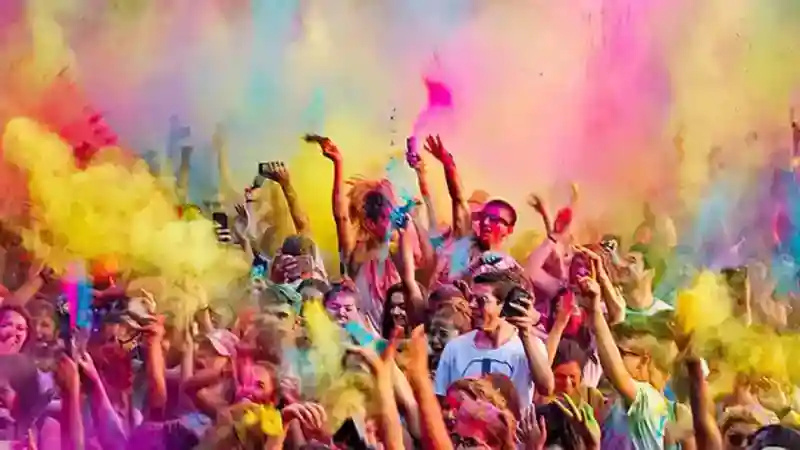
Origin of Holi:
There are many different ways that Holi is held in India, and according to tradition, the festival's origins may be traced to the Barsana region of that country, which includes Mathura, Nandgaon, Vrindavan, and Barsana.
History of Holi:
The name "Holika" was first used to refer to the historic Indian festival of Holi. Early religious texts like Jaimini's Kathaka-Grhya-Sutras and the Purva Mimamsa-Sutras provide in-depth descriptions of the festivals. According to historians, all Aryans celebrated Holi, though especially so in Eastern India. It is thought that Holi predated Christ by several centuries. The festival's significance, though, is said to have evolved over time. The full moon (Raka) was venerated in the past as part of a unique ritual carried out by married women for the happiness and well-being of their families. With its customs and traditions, the Holi festival is an old Hindu celebration. During the rule of Chandragupta II in the fourth century, it is referenced in the Puranas, Dasakumara Charita, and by the poet Klidsa. The Sanskrit play from the seventh century, Ratnavali, also mentions the festival of Holi. By the 17th century, the Holi celebration had captured the interest of British colonial employees and Foreign businessmen.
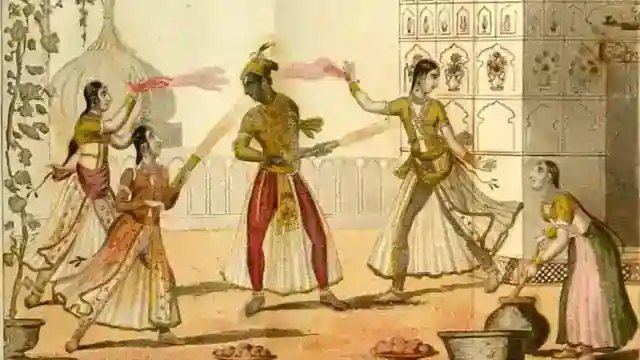
Along with comprehensive descriptions in the Vedas and Puranas like the Narad Purana and the Bhavishya Purana, Jaimini Mimansa also makes reference to the Holi festival. A stone inscription from 300 BC that was discovered at Ramgarh in the province of Vindhya mentions Holikotsav. In his treatise Ratnavali, which was written in the seventh century, King Harsha also mentions holi utsav. In his historical recollections, Ulbaruni, a well-known Muslim traveler, also noted the Holikotsav. Some Muslim authors of that era have noted that Muslims also observed Holikotsav, in addition to Hindus.
Legend and Mythology of Holi:
Holi Purnima is also observed as Shri Chaitanya Mahaprabhu's birthday in several parts of India, particularly in Bengal and Orissa (A.D. 1486-1533). However, the name "Holi" actually means "burning" when taken literally. The most famous of the many legends used to explain the meaning of this name is the one about the demon king Hiranyakashipu. Hiranyakashipu desired for everyone in his realm to worship just him, but much to his dismay, his son Prahlad developed a strong devotion to Lord Naarayana. Holika, the sister of Hiranyakashipu, was ordered to carry Prahlad into a raging fire. Due to a blessing, Holika could enter flames without suffering any personal harm. She was unaware that the boon only functioned when she entered the fire by herself. She was thus punished for her evil aspirations, but Prahlad was saved by god's favor because of his tremendous devotion.

This came to be known as “Holika Dahan” and is celebrated all over India a night just before the day of Holi. This celebration commemorates the triumph of devotion as well as the victory of virtue over evil. As the Lord established the custom of playing with colors by painting his lover Radha and the other gopis, the legend of Lord Krishna is also linked to color play. The play gradually gained popularity among the populace and developed into a tradition. Other stories connected to the festival include those of the ogresses Dhundhi and Pootana as well as Shiva and Kaamadeva. All show the triumph of good over evil, giving the celebration its philosophical underpinnings.
Significance of Holi:
The vividness of colours adds a lot of happiness to our lives, and Holi, the festival of colours, is essentially a day to celebrate. Holi is a well-known Hindu holiday that is fervently and joyfully observed throughout all of India. The ritual begins with the lighting of the bonfire one day prior to Holi, and this action represents the victory of good over evil. They play with colour on Holi Day with their friends and families, and in the evening, they show their loved ones their respect and affection by lighting an Abeer.
Holi has several features that make it so important for our lives despite being such a vibrant and flamboyant event. Holi's significance can be seen in many ways than one at first glance, even though they might not be immediately obvious. We have every reason to fervently celebrate the event and embrace the causes behind its celebrations, ranging from sociocultural to religious to biological. We will discuss the cultural and social significance of this festival here.
Cultural Significance:
The celebration of the numerous Holi legends serves to comfort the populace of the strength of truth because the message of all these tales is that good always triumphs over evil in the end. A further indication that great devotion to God pays off is provided by the Hiranyakashipu and Prahlad legend, who both attest to the fact that God will always provide for his loyal devotees.All of these myths encourage people to live moral lives and to value honesty. This is crucial in today's world because so many individuals torture those who are honest and use nasty tactics to achieve marginal profits.In addition, Holi is observed at a time of year when people are hoping for a successful harvest and the fields are in full bloom. This provides a fantastic excuse for the populace to celebrate, have fun, and immerse themselves in the Holi atmosphere.
Social significance:
Holi promotes racial harmony and bolsters our nation's secular foundation. Because everyone wants to take part in such a colourful and joyful holiday, the festival is also observed by non-Hindus. Also, it is customary to make friends with foes during Holi and forget about any hardships that may have existed. Other from that, no one makes a distinction between the rich and the poor on this day as everyone joins in on the holiday in a spirit of goodwill and unity.
After work, individuals visit friends and family to say hello and exchange gifts, treats, and pleasantries. This aids in revitalising connections and fortifying emotional ties among people.
Rituals of Holi:
Rituals of the ancient festival of Holi are religiously followed every year with care and enthusiasm.
Preparations:
Days before the festival people start gathering wood for the lighting of the bonfire called Holika at the major crossroads of the city. This ensures that at the time of the actual celebration a huge pile of wood is collected.
Holika Dahan Celebrations:
Then on the eve of Holi, Holika Dahan takes place. Effigy of Holika, the devil-minded sister of demon King Hiranyakashyap is placed in the wood and burnt. For, Holika tried to kill Hiranyakashyap's son Prahlad, an ardent devotee of Lord Narayana. The ritual symbolises the victory of good over evil and also the triumph of a true devotee.
Children also hurl abuses at Holika and pray pranks, as if they still try to chase away Dhundhi who once troubled little ones in the Kingdom of Prithu. Some people also take embers from the fire to their homes to rekindle their own domestic fires.
Play of Colours:
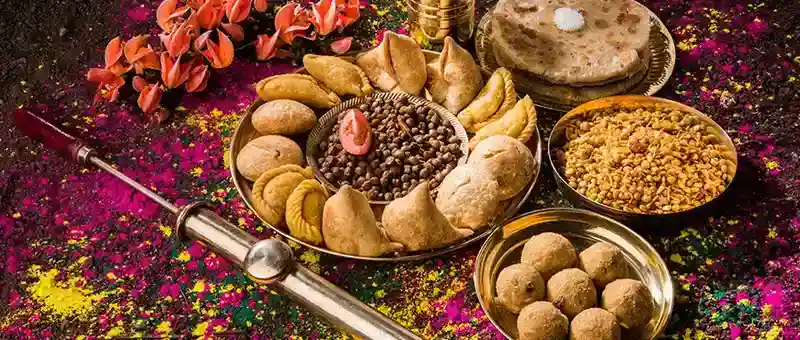
The next day, is of course the main day of Holi celebrations. The day is called Dhuleti and it is on this day that the actual play of colours takes place. There is no tradition of holding puja and is meant for pure enjoyment. The tradition of playing colours is particularly rampant in north India and even in that region, there can be no comparison to the Holi of Mathura and Vrindavan. In Maharashtra and Gujarat, too Holi is celebrated with a lot of enthusiasm and fun. People take extreme delight in spraying colour water on each other with pichkaris or pouring buckets and buckets of it. Singing Bollywood Holi numbers and dancing to the beat of dholak is also a part of the tradition. Amidst all this activity people relish gujiya, mathri, malpuas and other traditional Holi delicacies with great joy. Drinks, specially thandai laced with bhang is also an intrinsic part of the Holi festivity. Bhang helps to further enhance the spirit of the occasion but if taken in excess it might dampen it also. So caution should be taken while consuming it.
Holi Celebrations in South India:
In south India, however, people follow the tradition of worshipping Kaamadeva, the love god of Indian mythology. People have faith in the legend which speaks about the great sacrifice of Kaamadeva when he shot his love arrow on Lord Shiva to break his meditation and evoke his interest in worldly affairs.
After, an eventful and fun-filled day people become a little sober in the evening and greet friends and relatives by visiting them and exchanging sweets. Holi special get-togethers are also organised by various cultural organisations to generate harmony and brotherhood in society.
Holi Pooja:
The Holi Pooja is performed the day before the festival. The name of this day is Holika Dahan. On the day of Holi, no particular pooja is conducted. This day is only intended for festivities and the use of colour. The main Holika Dahan ceremony, which is also regarded as a significant Holi Puja, is done during the festival of Holi. On the eve of the Holi celebration, people build bonfires to commemorate the victory of "good" over "evil," known as Holika Dahan.
Celebration:
Holi is celebrated throughout the country in a beautiful way. The national holiday of Holi is celebrated with great jubilation and vigour. The level of public enthusiasm reaches its climax and equals the abundance of nature during Holi. Although Holi has long been a tradition in India, both its popularity and its level of commotion appear to be growing with each passing year. As no other event affords people as much freedom to let their hair down and indulge in their secret craziness. Differences of any kind are swept away in the Holi waters' vibrant hues, and people simply enjoy acting like playthings. We have a social licence to get a kick with the tradition of bhang in order to further improve the joyous mood of Holi celebrations. Eventually, when people begin to dance and chant loudly to traditional folk tunes, things go completely out of control.
Celebration of Holi in various states of India:
Holi is celebrated widely especially because it is famous in the states of Punjab, West Bengal, Uttar Pradesh, Rajasthan, Gujarat, Haryana etc..
The locations connected to the birth and early years of Lord Krishna, Mathura, Vrindavan, Barsana, and Nandgaon, are where it is celebrated with the most charm and zeal. When Barsana occurs, Holi takes on the name Lathmar Holi. As they arrive to play Holi with them, Barsana women give the Nandgaon men a hard time. All of this is done in the spirit of Holi, even when women beat, drag, and dress up the unfortunate captives.
Apart from the colour show, the practice of breaking the pot is undoubtedly the most pleasurable aspect of Holi. In the states of Maharashtra and Gujarat, it is observed with much fanfare. Here, a large pot of buttermilk is suspended above the streets. They stack themselves into a massive pyramid, and the top man crushes the pot with his head. Women continue to chant traditional Holi songs and hurl endless buckets of water throughout this entire ordeal. The custom has its origins in the mischievous Lord Krishna, who loved buttermilk so much that he used to take it from every house in the hamlet that was open to the public. They used to hang the butter up high to conceal it from young Krishna.
In West Bengal, “Dol Yatra '' is celebrated on the eve of Holi where people engage in processions playing with powdered colour, musically welcoming the festival.In the Bengali state, Holi is observed with the utmost respect. Holi is celebrated as the "Spring Festival" or "Basant Utsav '' at Vishwa Bharti University, which was founded by Rabindranath Tagore. Intricate rangolis and prabhat pheris are used by students to beautify the campus. Little boys and girls dressed traditionally perform songs written by Gurudev and offer an enchanted scene to the bystanders who have gathered in great numbers here. In some Bengali regions, Holi is observed as Dol Yatra, during which Radha and Krishna idols are carried in a procession on a decked palanquin.
As Sikhs meet at Anandpur Sahib to celebrate Hola Mohalla the day after Holi, they must demonstrate their physical prowess and military might. The ritual, which is still practised faithfully today, was established by Guru Gobind Singh Ji, the tenth and final guru of the Sikh religion.
Delicacies:
Like any other festival, Holi too is incomplete without food and drinks. Here are some delicacies of Holi.
1. Thandai
2. Gujiya
3. Besan Papdi
4. Puran Poli
5. Malpua
6. Dahi Vada
7. Barfi
8. Bhang
9. Bhang Pakora
10. Rasmalai
11. Namak Pare
12. Saffron Rice
Holi Date 2023:
Dol Yatra: 7th March, 2023
Holi: 8th March, 2023
Holika Dahan: 7th March(from 6 pm)