Rin Mochak Mangal Stotra: Lyrics, Meaning & Debt-Relief Benefits
By Pandit Vikram Joshi, Jyotish expert with 20+ years of experience in Graha Shanti traditions | Reviewed by Utsav editorial team
The Rin Mochak Mangal Stotra (ऋण मोचक मंगल स्तोत्र) is a sacred Vedic hymn dedicated to Lord Mangal (Mars) for freedom from all forms of debt. Traditionally found within the Skanda Purana, this stotra isn't just for financial relief; it's a powerful tool to clear karmic, ancestral, and spiritual debts that block progress. Chanting it with devotion, especially on Tuesdays, invokes Mars' energy of courage and action to overcome obstacles.
Quick Answer
- What: A powerful Vedic hymn to Lord Mangal (Mars) to remove financial, karmic, and ancestral debts.
- When: Most effective when chanted on a Tuesday (Mangalvar), the day ruled by Mars.
- Why: To gain courage, overcome financial struggles, and clear negative karmic patterns associated with Mars's influence in one's horoscope.
- Source: Traditionally attributed to the Skanda Purana, one of the eighteen major Puranas.
Table of Contents
- Who Is Lord Mangal?
- Rin Mochak Mangal Stotra: Complete Lyrics in English
- Verse-by-Verse Meaning of the Stotra
- Why Is This Stotra So Powerful for Debt Relief?
- What Are the Benefits of Chanting?
- How to Chant the Stotra: The Complete Vidhi
- Sources & References
Who Is Lord Mangal, The Remover of Debts?
In Vedic astrology, Lord Mangal, also known as Angaraka or Kuja, is the son of Bhumi (Earth) and represents courage, action, energy, and aggression. A weak or afflicted Mars in a devotee's birth chart can manifest as debt, conflict, and a lack of motivation. So, what does this mean for you? It means that propitiating Mangal is essential for tackling these life challenges head-on. As the Skanda Purana describes, he is the Rin-Harta—the remover of debts—who grants the strength to face and resolve financial and karmic burdens.
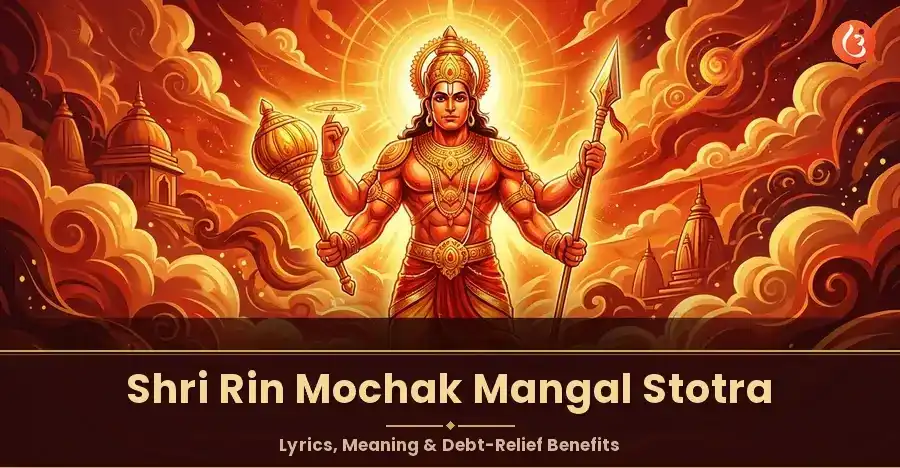
His iconography reinforces these qualities; he is often depicted riding a ram (Mesha), his zodiacal sign of exaltation, symbolizing fiery determination. The weapons he carries, such as a spear or trident, represent his power to pierce through ignorance and obstacles.
मङ्गलो भूमिपुत्रश्च ऋणहर्ता धनप्रदः।
स्थिरासनो महाकायः सर्वकर्मविरोधकः॥ १॥Mangalo bhumiputrashcha runaharta dhanapradah |
Sthirasano mahakayah sarvakarmavirodhakah || 1 ||
This opening verse itself establishes his primary function. He doesn't just magically erase debt; he provides the energy and removes the obstacles that prevent you from clearing it yourself. It’s a powerful distinction.
Rin Mochak Mangal Stotra – Complete Lyrics in English
Here is the full text of the Rin Mochak Mangal Stotra for devotees to read and recite. The text is presented uninterrupted, as is traditional for chanting.
Verse 1-4
Mangalo bhumiputrashcha runaharta dhanapradah |
Sthirasano mahakayah sarvakarmavirodhakah || 1 ||
Lohito lohitakshashcha samaganam krupakarah |
Dharatmjah kujo bhaumo bhutido bhuminandanah || 2 ||
Angarako yamashchaiv sarvarogapaharakah |
Vrushteah karta’paharta ch sarvakamafalapradah || 3 ||
Etani kujanmani nityan yah shraddhaya pathet |
Runan n jayate tasya dhanan shighramavapnuyat || 4 ||
Verse 5-8
Dharanigarbhasambhutan vidyutkantisamaprabham |
Kumaran shaktihastan ch mangalan pranamamyaham || 5 ||
Stotramangarakasyaitatpathaniyan sada nrubhiah |
N teshan bhaumaja pida svalpa’pi bhavati kvachit || 6 ||
Angarak mahabhag bhagavanbhaktavatsal |
Tvan namami mamasheshhamrunamashu vinashaya || 7 ||
Runarogadidaridrayan ye chanye hyapamrutyavah |
Bhayakleshamanashtapa nashyantu mam sarvada || 8 ||
Verse 9-11
Ativakr duraradhya bhogmukt jitatmanah |
Tushto dadasi samrajyan rushto harasi tatkshanat || 9 ||
Virinchi shakr vishnunam manushyanam tu ka katha |
Ten tvan sarvasattven graharajo mahabalah || 10 ||
Putran dehi dhanam dehi tvaamasmisharanam gatah |
Runadaridrayaduhkhen shatrunam ch bhayattatah || 11 ||
Verse-by-Verse Meaning of the Rin Mochak Mangal Stotra
Understanding the meaning behind the verses deepens the devotional experience. Here’s what each part of this powerful stotra signifies, according to Jyotish pandits.
Verse 1: "I bow to Mangal, the son of the Earth, who is the remover of debts and the giver of wealth. He is firm in his seat, has a mighty form, and obstructs all negative actions."
This verse sets the intention. You're acknowledging his power to both remove the negative (debt) and grant the positive (wealth).
Verse 2: "He is red in color, has red eyes, and is compassionate to those who sing the Sama Veda. He is the son of Earth, known as Kuja, Bhauma, the giver of existence, and the delight of the Earth."
Here, we praise his form and lineage, connecting him directly to the life-giving energy of Bhumi (Earth).
Verse 3: "He is Angaraka, and also Yama (the controller of death), the remover of all diseases. He is the creator and destroyer of rain and the bestower of the fruits of all desires."
This expands his domain beyond just debt to health, sustenance, and the fulfillment of righteous desires. It's about total life stability.
Verse 4: "Whoever recites these names of Kuja (Mars) daily with faith will never incur debt and will quickly attain wealth."
This is the Phala Shruti or the promise of the stotra. The text itself guarantees the result of sincere chanting.
Verse 5: "I bow to Mangal, who was born from the womb of the Earth, who shines with the brilliance of lightning, the young god holding a spear (Shakti)."
A powerful visualization of his dynamic and energetic form. You're not praying to a static force, but a vibrant, active one.
Verse 6: "This stotra of Angaraka should always be recited by people. For them, even the slightest affliction caused by Mars will never occur."
It’s a shield. Regular chanting is described as a protective measure against the astrological challenges posed by Mars.
Verse 7: "O Angaraka, the greatly fortunate one, O Lord who is affectionate to your devotees, I bow to you. Please quickly destroy all my debts."
This is a direct, personal appeal. After praise, you state your specific need with humility and devotion.
Verse 8: "Debts, diseases, poverty, and other causes of untimely death, fear, suffering, and mental anguish—may they always be destroyed for me."
The prayer expands from just financial debt to all forms of life's suffering. It's a holistic request for peace and security.
Verse 9 & 10: "O you who are very crooked and difficult to please, yet you grant kingdoms when pleased and take them away in an instant when angered. When even Brahma, Indra, and Vishnu are subject to your influence, what can be said of humans? Therefore, you are the mighty king of all planets."
This acknowledges his immense power. It shows you understand his cosmic importance, which is key to earning his grace.
Verse 11: "Give me sons, give me wealth, I have come to you for refuge from the misery of debt, poverty, and the fear of enemies."
The final, ultimate surrender. You place your worldly needs and fears at his feet, accepting him as the ultimate protector.
Why Is This Stotra So Powerful for Debt Relief?
Vedic tradition views "debt" as more than just a financial problem. The principles of Jyotish explain that it's a symptom of deeper imbalances. The Rin Mochak Mangal Stotra works because it addresses three kinds of debt.
- Financial Debts (Dhana Rin): This is the most obvious one. An afflicted Mars can create impulsive spending, conflicts over money, and unforeseen expenses. The stotra energizes you with the discipline and courage (key Martian traits) to manage finances and find new income sources.
- Karmic Debts (Karma Rin): These are debts from past actions, in this life or previous ones. Mars governs action (karma), and this stotra helps pacify the negative effects of past aggression, anger, or harm, which often manifest as obstacles in the present.
- Ancestral Debts (Pitra Rin): Sometimes, we carry the energetic or financial burdens of our ancestors. Mars is connected to land and property (as son of Bhumi), and chanting this stotra can help resolve long-standing issues related to ancestral property and karmic patterns.
This hymn is a complete remedy. It’s not just about wealth, much like the powerful Kanakdhara Stotra invokes Goddess Lakshmi for a flow of abundance. It's about restoring cosmic balance in your life.
What Are the Benefits of Chanting This Stotra?
According to Vaidik pandits and Jyotish experts, regular and sincere chanting of the Rin Mochak Mangal Stotra brings profound changes.
- Clears Financial Blockages: It's known to create pathways for clearing loans, mortgages, and other financial liabilities.
- Boosts Courage and Confidence: It directly impacts your willpower, helping you face difficult situations and overcome procrastination.
- Reduces Mangal Dosha Effects: For those with Mangal Dosha (an astrological condition affecting marriage), this stotra can help mitigate its negative effects on relationships and resolve conflicts.
- Improves Health: Since Mars governs energy and vitality, chanting can help with blood-related ailments and boost overall physical strength.
- Protects from Enemies and Negativity: The stotra acts as a kavach (shield), protecting you from hidden enemies and negative energies.
- Resolves Property Disputes: As the son of Bhumi, Mangal’s grace is essential for resolving issues related to land and real estate. This includes helping with marital harmony, a domain where hymns like the Uma Maheshwar Stotra are also highly effective.
- Overcomes Lethargy and Procrastination: By energizing the Muladhara (root) chakra, the stotra instills a proactive mindset, helping one take decisive action.
How to Chant the Stotra: The Complete Vidhi
For the stotra to be effective, following the correct procedure (vidhi) is essential. It aligns your intention with the cosmic energies.
- Preparation: Begin by taking a bath and wearing clean red clothes. Red is the color associated with Lord Mangal.
- Timing: The best time to start is on a Tuesday (Mangalvar) during the Shukla Paksha (waxing moon phase). The ideal time of day is just after sunrise.
- Setup: Place an image or idol of Lord Mangal or Lord Hanuman (who helps control Mars's energy) on a clean altar. Face east while chanting.
- Offerings: Light a ghee lamp and offer red flowers (like hibiscus), red sandalwood paste, and a sweet made from jaggery.
- Sankalp (Intention): Hold a little water in your right palm and state your name, gotra, and your specific wish for debt removal. Let the water flow to the ground.
- Recitation: Chant the stotra with clear pronunciation and devotion. It is recommended to recite it 11, 21, or 108 times, depending on the severity of your situation. For daily practice, chanting it once with full focus is also very powerful.
- Closing: After the recitation, perform a small aarti and ask for forgiveness for any mistakes made during the prayer.
- Prasad and Consistency: Consume the sweet offered as prasad. For best results, maintain consistency by chanting this stotra every Tuesday for at least 21 consecutive weeks.
Scripture Composer/History
The Rin Mochak Mangal Stotra originates from the Skanda Purana, one of the eighteen Mahapuranas in Hinduism. The authorship of the Puranas is traditionally attributed to Maharishi Veda Vyasa, who is revered for compiling these vast sacred encyclopedias to make complex Vedic wisdom accessible to all. Composed in classical Sanskrit, its origins are rooted in the Puranic period (c. 400-1000 CE). Unlike stotras authored by specific historical saints, this hymn is an integral part of the Puranic narrative itself, presented as a divine remedy. For centuries, it has been transmitted through oral tradition by priests and astrologers (jyotishis) and preserved within the manuscript lineage of the Skanda Purana, solidifying its authority as a powerful astrological and spiritual solution for devotees.
Sources & References
Scriptural Authority:
- Skanda Purana: The traditional origin text for the Rin Mochak Mangal Stotra.
- Jyotish Shastras: Vedic astrological texts like Brihat Parashara Hora Shastra which detail the influence of Mangal (Mars).
Astrological Verification:
- Principles of Graha Shanti (planetary pacification) as practiced by verified Vaidik pandits.
Panchang & Dates:
- Timing and auspicious days cross-referenced with the Utsav Panchang for 2026.