Brahma Ji Aarti: Lyrics, Meaning & The Story of His Lost Worship
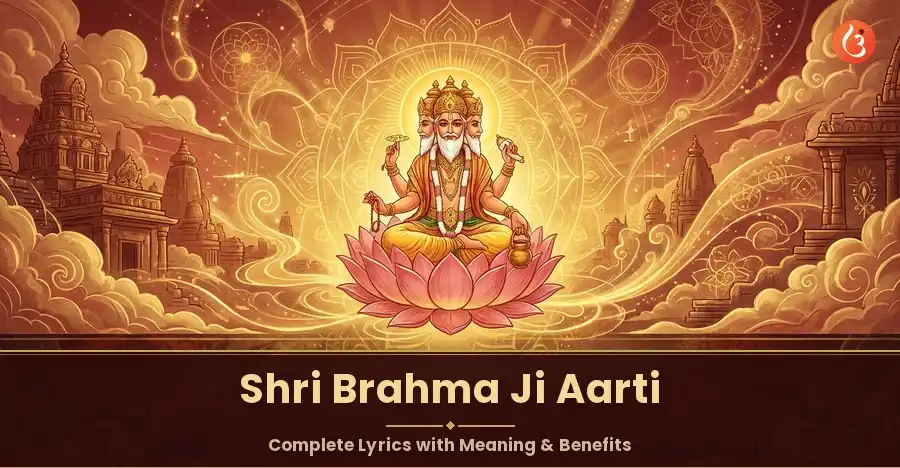
Shri Brahma Ji Aarti (श्री ब्रह्मा जी आरती) is a devotional hymn dedicated to Lord Brahma, the Creator of the universe and one of the three principal deities in the Hindu Trimurti. He is the cosmic architect, the Prajapati or Lord of all creatures, from whose mind the universe unfolds. According to the Puranas, this Aarti venerates the source of all creation and knowledge. While his worship isn't as widespread as that of Vishnu or Shiva, chanting his Aarti aligns the devotee with the cosmic forces of creation, wisdom, and new beginnings. It is a powerful practice for students, artists, and anyone embarking on a new venture, seeking the blessings of the ultimate creative source.
Quick Answer
- What: A devotional hymn honoring Lord Brahma (ब्रह्मा), the cosmic Creator and source of the four Vedas.
- Why Chant It: To connect with the energy of creation, seek blessings for knowledge, and honor the entire Trimurti.
- The Core Story: Brahma's worship is limited due to a curse, often cited in the Shiva Purana, which makes this Aarti a unique and profound practice.
- How to Chant: Typically performed in the morning after a bath, facing east, with a ghee lamp and incense.
Table of Contents
- Complete Brahma Ji Aarti Lyrics
- Meaning of the Brahma Ji Aarti
- Why Is Lord Brahma Not Widely Worshipped?
- How to Perform Brahma Ji Aarti: The Correct Vidhi
- The Deep Symbolism of Lord Brahma
- Sources & References
Complete Brahma Ji Aarti Lyrics
Here is the full text of the Shri Brahma Ji Aarti for recitation. As per tradition, it begins by establishing a deep connection with the divine as the ultimate guardian and protector.
Pitu Matu Sahayak Svami Sakha, Tum Hi Ek Nath Hamare Ho.
Jinake Kuchh Aur Adhar Nahin, Tinake Tum Hi Rakhware Ho.Sab Bhati Sada Sukhadayak Ho, Dukh Nirgun Nashan Hare Ho.
Pratipal Kare Sare Jag Ko, Atishay Karuna Ur Dhare Ho.Bhool Gaye Hain Ham To Tumako, Tum To Hamari Sudhi Nahin Bisare Ho.
Upakaran Ko Kachhu Ant Nahin, Chhinn Hi Chhinn Jo Vistare Ho.Maharaj Maha Mahima Tumhari, Mujhase Virale Budhavare Ho.
Shubh Shanti Niketan Prem Nidhi, Man Mandir Ke Ujiyare Ho.Is Jivan Ke Tum Hi Jivan Ho, In Pranan Ke Tum Pyare Ho Mein.
Tum Son Prabhu Paye “Kamal” Hari, Kehi Ke Ab Aur Sahare Ho.
Meaning of the Brahma Ji Aarti
Understanding the words transforms the Aarti from a ritual into a heartfelt conversation. Here’s what each verse means, a translation that captures the devotional essence described in many Puranic traditions.
Verse 1: Pitu Matu Sahayak...
You are my Father, Mother, Helper, Lord, and Friend—you are my only true guardian. For those who have no other support, you alone are their protector. This opening verse establishes the concept of Brahman as the ultimate relation, the source from which all worldly relationships derive their meaning. It’s a total surrender, acknowledging that all forms of support are manifestations of one divine source.
Verse 2: Sab Bhati Sada...
You always bring happiness in every way and destroy all suffering and negative qualities. You sustain the entire universe, holding immense compassion in your heart. The phrase "Dukh Nirgun Nashan Hare Ho" implies that Lord Brahma removes not just overt suffering but also the subtle, formless afflictions (nirgun) that arise from ignorance. This verse acknowledges Brahma's role as the sustainer of cosmic order.
Verse 3: Bhool Gaye Hain...
Even if we, engrossed in worldly matters, have forgotten you, you have never forgotten to take care of us. There is no end to the instruments of your creation, which you expand moment by moment. This reflects the Hindu concept of ceaseless creation (srishti), where the universe is in a constant state of flux and expansion, all under the silent, watchful grace of the Creator. It's a beautiful reminder of constant divine grace.
Verse 4: Maharaj Maha Mahima...
O great Lord, your glory is immense; wise ones like me can barely comprehend it. You are the abode of auspiciousness and peace, the treasure of love, and the light that illuminates the temple of my mind. The metaphor "Man Mandir Ke Ujiyare Ho" is profound; it suggests that Brahma's wisdom is the inner light that dispels the darkness of ignorance (avidya) and reveals the true Self within.
Verse 5: Is Jivan Ke Tum...
You are the very life of this life, the beloved of my vital breath (prana). Having found you, O Lord, what other support could I possibly need? This is the ultimate declaration of finding fulfillment in the divine. It expresses a state of ananya bhakti, or single-pointed devotion, where the devotee sees the Lord as the essence of their own existence and the final destination of their spiritual journey.
Why Is Lord Brahma Not Widely Worshipped?
Have you ever wondered why there are so few temples dedicated to the Creator himself? The reason is rooted in powerful stories from the Puranas that serve as cautionary tales about ego and truthfulness.
According to the Shiva Purana (Vidyeshvara Samhita, Chapter 9), a dispute arose between Brahma and Vishnu about who was supreme. To settle it, Lord Shiva appeared as an infinite pillar of light (a Jyotirlinga) and challenged them to find its end. Vishnu took the form of a boar (Varaha) and went down, while Brahma took the form of a swan (Hamsa) and flew up. Neither could find an end. While Vishnu honestly admitted his failure, Brahma lied, claiming he had reached the top. As false evidence, he presented a Ketaki flower, which he had persuaded to bear false witness for him.
Angered by this deceit, Lord Shiva appeared and cursed Brahma, declaring that he would no longer be worshipped by devotees on Earth due to his dishonesty. Shiva also cursed the Ketaki flower, decreeing it would never again be used in his worship. This is why, with a few exceptions like the Pushkar temple, you don't find a widespread tradition of Brahma worship.
Another less-cited story from the Skanda Purana involves Brahma's creation of Shatarupa, a being of immense beauty. Brahma became infatuated with her and grew heads in every direction to always keep her in his sight. His unbecoming desire was seen as a transgression against the cosmic order. Lord Shiva, in his fierce Bhairava form, intervened to check Brahma's ego, further diminishing his stature for worship.
Chanting his Aarti, therefore, becomes a very conscious act of honoring the Creator's fundamental role, acknowledging cosmic history, and focusing on the pure, creative aspect of the divine, separate from the Puranic narratives of his fallibility.
How to Perform Brahma Ji Aarti: The Correct Vidhi
Performing the Aarti with the proper method (vidhi) enhances its spiritual impact. While there aren't as many rigid rules as with other deities, following a respectful procedure is essential. The process is similar to other Aartis, like the one for Lord Ganesha, which you can learn about in our Ganesh Aarti guide.
- Purification: Begin by taking a bath and wearing clean clothes. A clean body and mind are key. The best time is during Brahma Muhurta (around 1.5 hours before sunrise). This period is known as "The Creator's Hour" because the mind is naturally calm and receptive to spiritual energy, making it ideal for connecting with Lord Brahma.
- Prepare the Space: Clean the area where you'll perform the Aarti. Place an image or idol of Lord Brahma on a clean cloth, preferably yellow, as this color is associated with knowledge and auspiciousness.
- Light the Lamp: Light a ghee lamp with one or three wicks. The lamp's flame symbolizes the light of knowledge dispelling the darkness of ignorance. You can also light incense sticks (agarbatti) to purify the atmosphere.
- Invocation: Close your eyes and meditate on Lord Brahma as the creator of the universe. Offer fresh flowers, particularly white or yellow ones like jasmine or lotus, with reverence. You can recite a simple mantra like "Om Brahmane Namah" to invoke his presence.
- Chant the Aarti: Sing the Aarti with devotion (bhava) and clear pronunciation while gently circling the lamp in a clockwise direction in front of the deity's image. Feel the meaning of the words connecting your heart to the divine.
- Conclusion: After the Aarti, cup your hands over the flame and bring them to your eyes and head to receive the divine energy and blessings. Offer your personal prayers and distribute any prasad (blessed food offering) you may have prepared.
- Silent Contemplation: It is beneficial to sit in silence for a few minutes after the Aarti. This allows you to absorb the peaceful vibrations and internalize the spiritual energy generated during the ritual.
For the Hindi version of this Aarti, you can read our Shri Brahma Aarti in Hindi guide.
The Deep Symbolism of Lord Brahma
Every aspect of Lord Brahma's iconography, as described in various Hindu texts, is rich with meaning. It’s not just an image; it’s a map of cosmic principles that reveals the nature of creation and knowledge.
- The Four Heads: His four heads represent the four Vedas (Rig, Yajur, Sama, and Atharva), the foundational scriptures of Hinduism that emerged from him. They also symbolize the four Yugas (ages), the four Varnas (social orders), and the four cardinal directions, signifying that all knowledge, time, and space emerge from his consciousness.
- The Lotus (Kamal): Brahma is often shown seated on a lotus that springs from the navel of Lord Vishnu. This signifies that he was born from the cosmic potential of the universe, representing purity, divine birth, and spontaneous creation. Just as the lotus grows in mud but remains unstained, creation arises from the formless divine without being tainted by the material world.
- The Swan (Hamsa): His vahana (vehicle) is the swan. The swan is mythologically gifted with Neera-Ksheera Viveka—the ability to separate milk from water. This symbolizes the essential quality of a spiritual seeker: the wisdom (viveka) to discern truth (Brahman) from illusion (Maya) and good from evil. The Hamsa is also associated with the breath, as the inhalation and exhalation sound like "So-Ham," meaning "I am He," a constant reminder of the unity of the individual self with the universal spirit.
- The Akshamala (Rosary): In one hand, he holds a rosary. This symbolizes time and its cycles. The beads represent the cosmic timeline—from yugas to kalpas—which Brahma controls. It signifies that all of creation is bound by time, and he is its master.
- The Pustaka (Book): The book he holds is a manuscript of the Vedas, representing divine, unadulterated knowledge. This reinforces his role as the ultimate source of wisdom, science, arts, and dharma. All forms of knowledge required for a righteous life flow from him.
- The Kamandalu (Water Pot): This pot contains the primordial water of creation (Amrita), the causal element from which all life emerged. It symbolizes the cosmic energy and the life-giving essence that sustains the universe.
- The White Beard: Brahma’s long white beard denotes his eternal nature and the infinite wisdom of the first-born being. It signifies his status as the Pitamaha, the great grandsire of the entire cosmos.
Scripture Composer/History
The popular hymn Pitu Matu Sahayak Svami Sakha, widely used as the Shri Brahma Ji Aarti, is a modern devotional composition. It is attributed to the tradition of the 19th-century Punjabi theologian and writer, Pandit Shraddha Ram Phillauri (1837–1881), who is also credited with composing the universal aarti "Om Jai Jagdish Hare." Unlike ancient stotras derived from the Puranas or Vedas, this aarti is composed in accessible, vernacular Hindi with Brajbhasha influences, designed for community worship. It does not have a scriptural lineage in texts like the Mahabharata or Skanda Purana. Instead, it emerged from the later Bhakti movement and was popularized through oral tradition and congregational singing, making it a staple in household and temple prayer books.
Sources & References
Scriptural Authority:
- Trimurti Concept: Referenced across multiple Puranas, including the Padma Purana and Bhagavata Purana.
- Brahma's Curse: The primary narrative is found in the Shiva Purana (Vidyeshvara Samhita), with variations in other texts like the Skanda Purana.
Iconography & Symbolism:
- The symbolism of Brahma's form is explained in various Agamas and Shilpa Shastras (treatises on art and sculpture).
Aarti Tradition:
- The Aarti is part of the Bhakti oral tradition, passed down through generations.