Ashta Dasa Mahavidyas: Guide to the 18 Forms of Shakti
By Pandit Ravi S., Expert in Tantric & Shakta Traditions | Reviewed by Utsav editorial team
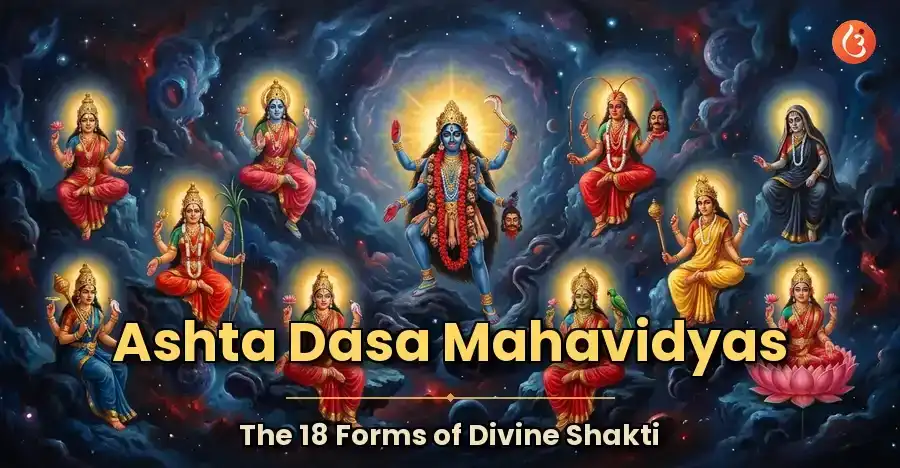
The Ashta Dasa Mahavidyas are the 18 "Great Wisdom Goddesses" who represent the complete and formidable power of Adi Parashakti. According to the Maha Bhagavata Purana, the core ten Mahavidyas emerged from Goddess Sati's fury. They embody the entire spectrum of divine feminine energy, from gentle creation to fierce dissolution.
Quick Answer
- What: The Ashta Dasa Mahavidyas (अष्ट दश महाविद्या) are a group of 18 powerful Tantric goddesses in Shaktism.
- Why: They represent the full range of Shakti's (divine feminine) wisdom, power, and consciousness.
- Key Groups: The goddesses are often categorized as Saumya (gentle) like Tripura Sundari and Raudra (fierce) like Kali and Chhinnamasta.
- How to Participate: You can connect with their energy by participating in specific Mahavidya pujas for goddesses like Bagalamukhi, Matangi, and Kamala.
Table of Contents
- What Are the Ashta Dasa Mahavidyas?
- The Core Ten: Origin of the Dasha Mahavidyas
- Saumya vs. Raudra: The Gentle & Fierce Faces of Shakti
- The Dasha Mahavidyas: A Closer Look
- The Expanded Eight: The Tantric Spectrum
- Why Do Devotees Worship the Mahavidyas?
- Participate in Mahavidya Pujas on Utsav
- Sources & References
What Are the Ashta Dasa Mahavidyas?
The Ashta Dasa Mahavidyas aren't just a list of goddesses; they are a complete philosophical system within Shaktism. The term "Mahavidya" itself means Great Wisdom. As verified pandits explain, each goddess is a pathway to a specific kind of spiritual knowledge. They represent the ten fundamental aspects of reality and consciousness, later expanded in some Tantric traditions to a fuller spectrum of 18.
Here, "Vidya" implies more than intellectual learning; it signifies direct, experiential insight into the nature of reality. Their worship is a core practice in Tantra, offering a direct, though often intense, path to liberation that contrasts with the more gradual Vedic rituals. Some Shakta traditions even draw a parallel between the ten Mahavidyas and the ten avatars of Vishnu, seeing them as the source from which the Dashavatara manifest their power.
This isn't just about mythology. It's a profound map of cosmic energy. Worshipping them is a way to understand the universe and your place in it. You're engaging with everything from creation (Bhuvaneshwari) and prosperity (Kamala) to the power that dissolves illusion (Dhumavati) and stops evil (Bagalamukhi). It’s a holistic path.
The Core Ten: Origin of the Dasha Mahavidyas
The story of the first ten Mahavidyas is one of the most powerful in Hindu scripture. The Maha Bhagavata Purana and other Devi-centric texts narrate this dramatic origin. It began when Sati, an incarnation of Shakti, was determined to attend her father Daksha's grand yajna, even though he had deliberately insulted her husband, Shiva. Daksha, a powerful Prajapati (creator-god), despised Shiva for his ascetic ways and refused to invite the divine couple.
Shiva forbade her from going. He knew it would only lead to dishonor. But Sati's resolve hardened into divine fury. To show Shiva her true, unstoppable power, she multiplied into ten terrifying and magnificent forms. These goddesses surrounded Shiva from all ten directions, completely subduing him. Kali stood before him, Tara appeared above, Bhuvaneshwari to his right, and Bhairavi to his left, with the others blocking every path. Overwhelmed by this awesome display, Shiva gave his consent. Each form was a Mahavidya. This event wasn't an argument; it was a cosmic revelation of Shakti's supreme authority.
Saumya vs. Raudra: The Gentle & Fierce Faces of Shakti
Devotees often find it helpful to understand the Mahavidyas through their two primary temperaments, a classification rooted in Tantric philosophy. This isn't about "good" vs. "evil"—it's about different cosmic functions. It's a spectrum of divine power.
Saumya (सौम्य) - The Gentle Forms:
These goddesses embody creation, preservation, beauty, wealth, and spiritual grace. They are approachable and nurturing. Think of them as the creative and sustaining energies of the universe.
- Examples: Tripura Sundari (goddess of divine beauty), Bhuvaneshwari (ruler of the material world), Matangi (patron of arts and knowledge), and Kamala (goddess of prosperity).
Raudra (रौद्र) - The Fierce Forms:
These goddesses represent the destructive, transformative, and often terrifying aspects of the divine. They destroy ignorance, ego, and evil. Their energy is intense, protective, and purifying. Don't mistake their fierceness for malevolence; it's the fierce love of a mother protecting her children.
- Examples: Kali (the ultimate reality), Chhinnamasta (self-sacrifice), Dhumavati (the void), and Bagalamukhi (the power to paralyze enemies).
It is crucial to remember this division is not absolute. Saumya goddesses can assume terrible forms to vanquish evil, as Tripura Sundari did when she defeated the demon Bhandasura. Similarly, Raudra goddesses often display profound compassion. Kali, despite her fearsome appearance, is revered as the ultimate mother who grants moksha to her devotees. The form a devotee experiences often reflects their own inner state and spiritual needs.
The Dasha Mahavidyas: A Closer Look
The ten primary Mahavidyas, as described in texts like the Todala Tantra, are the most widely recognized. Each represents a fundamental truth about the universe.
- Kali (काली): The ultimate reality, beyond time and space. Her dark form represents the unmanifest state from which all creation arises and to which it returns. She is the power of transformation.
- Tara (तारा): The compassionate saviouress, who guides devotees across the ocean of existence (samsara). Her worship is believed to grant immediate relief from suffering and is associated with the power of the spoken word.
- Tripura Sundari (त्रिपुर सुन्दरी): Also called Shodashi, she represents divine beauty, love, and enlightenment. Seated on a throne held by Brahma, Vishnu, and Shiva, she signifies supreme sovereignty. The highest form of Saumya energy.
- Bhuvaneshwari (भुवनेश्वरी): The queen of the universe, whose body is the cosmos itself. She embodies the primordial space (akasha) that allows all things to exist. She represents space and creation.
- Bhairavi (भैरवी): The fierce warrior goddess, the power of death, decay, and divine wrath against adharma. She is the consort of Bhairava and embodies the destructive energy needed to pave the way for new creation.
- Chhinnamasta (छिन्नमस्ता): The self-decapitated goddess, symbolizing self-sacrifice, the life-giving cycle, and control over desire. She feeds her own blood to her attendants, demonstrating the interdependence of life, death, and nourishment. Truly a shocking form.
- Dhumavati (धूमावती): The widow goddess, representing the cosmic void before creation and after dissolution. She teaches the wisdom found in letting go, in emptiness, and in the unattractive aspects of life. She is worshipped for overcoming suffering.
- Bagalamukhi (बगलामुखी): The goddess who paralyzes and silences enemies. She is depicted with a crane's head and holds a club to smash misconceptions and a tongue to stop malicious speech. She wields the power to stop all motion and evil intent.
- Matangi (मातंगी): The "Tantric Saraswati," she governs knowledge, music, and the arts, especially what is considered "left-over" or impure. She represents the power of speech and the wisdom gained from direct experience.
- Kamala (कमला): The "Tantric Lakshmi," she is the goddess of wealth, fortune, and worldly abundance. Seated on a lotus and bathed by elephants, she bestows both material and spiritual prosperity. Her grace is sought for material well-being.
The Expanded Eight: The Tantric Spectrum
While the Dasha Mahavidyas are central, certain Tantric traditions, particularly those referenced in texts like the Chamunda Tantra, expand the group to 18 to create a more complete system. This isn't a contradiction; it's an elaboration. The list of the additional eight can vary slightly, but a commonly accepted set includes powerful forms that fill specific niches.
Why the expansion? It’s to cover every possible aspect of divine intervention and spiritual reality. This expansion bridges esoteric Tantra with mainstream Shaktism by formally including goddesses like Durga and Annapurna within the Mahavidya framework. These additional goddesses often represent more specific powers or fusions of other deities. For example, Neel Saraswati combines the knowledge of Saraswati with the fierce protective power of Tara. This shows the intricate and interconnected nature of the many forms of Maa Durga.
The additional eight Mahavidyas typically include:
- Durga: The invincible warrior goddess who protects the dharma.
- Annapurna: The goddess of food and nourishment, ensuring sustenance.
- Gayatri: The embodiment of the sacred Vedic mantra, representing spiritual illumination.
- Vani (Saraswati): The goddess of pure knowledge, music, and divine speech.
- Lakshmi: The goddess of universal prosperity, beauty, and fortune.
- Chandi: A fierce, consolidated form of the Devi, celebrated in the Devi Mahatmyam.
- Vagala: Often considered a variant of Bagalamukhi, focused on silencing internal and external foes.
- Neel Saraswati: A fierce form of Tara, who grants mastery over wisdom and speech.
Why Do Devotees Worship the Mahavidyas?
People don't just worship the Mahavidyas for blessings; they approach them for profound transformation. According to practitioners, engaging with these goddesses is a direct path to moksha (liberation). Each Mahavidya offers a unique key to unlock a different aspect of your consciousness.
This worship, or sadhana, is highly specific. A yogi might worship Chhinnamasta to gain control over life-force energy (prana) and awaken the kundalini. Someone experiencing profound loss or despair might turn to Dhumavati to find wisdom in hardship and develop detachment. An artist or scholar would seek the grace of Matangi to achieve excellence in their craft. Families and business owners often pray to Kamala for prosperity and success.
What does this mean for you? If you're facing persistent obstacles, you might be drawn to Bagalamukhi. If you're seeking profound creative or academic knowledge, you might connect with Matangi or Neel Saraswati. The worship of these goddesses is highly personalized. It's about finding the specific divine energy you need to overcome your karmic challenges and realize your true potential. This is a powerful and active form of devotion that requires courage, sincerity, and often the guidance of a qualified guru.
Participate in Mahavidya Pujas on Utsav
Connecting with the energy of the Mahavidyas is possible through authentic, powerful rituals performed by verified pandits. Utsav offers a way for devotees to participate in these pujas from anywhere.
Recommended Pujas:
- Sri Kamalatmika Matangi Sanyukt Beej Mantra Jaap & Hawan: For knowledge, creativity, and abundance. Dakshina from ₹851.
- Maha Neel Saraswati Mahatantra Havan: For overcoming ignorance and gaining profound wisdom. Dakshina from ₹851.
- Maa Baglamukhi Ashtakam Path: For protection from enemies and silencing negative forces. Dakshina from ₹501.
When you participate, a pandit performs the ritual chanting your Naam and Gotra. You receive a video of the puja and authentic prasad delivered to your home. Explore all the powerful Goddess Durga Mantras and their benefits to deepen your practice.
Sources & References
Scriptural Authority
- Maha Bhagavata Purana & Devi Bhagavata Purana: Narrates the origin of the Dasha Mahavidyas from the fury of Goddess Sati.
- Todala Tantra & Chamunda Tantra: Key Tantric texts that codify the lists of 10 and 18 Mahavidyas, their mantras, and their iconographies.
- Mundamala Tantra: Describes the fierce (Raudra) aspects of the goddesses and their worship.
Temple Verification
- Kamakhya Temple (Guwahati, Assam): A primary Shakti Peeth where several Mahavidyas, including Matangi and Kamala, have dedicated shrines and are actively worshipped.