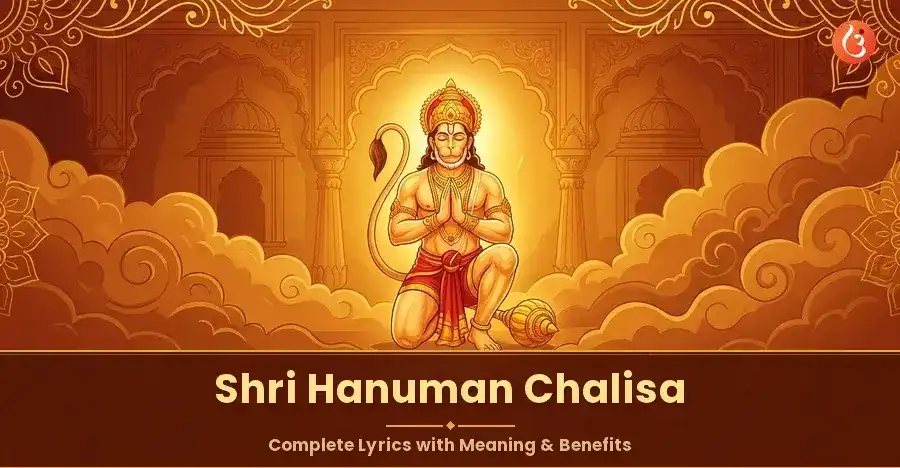
Hanuman Chalisa: Complete Lyrics, Meaning & Benefits
By Pandit Ravi S., Awadhi Tradition Scholar | Reviewed by Utsav editorial team
The Hanuman Chalisa (हनुमान चालीसा) is a 40-verse devotional hymn in the Awadhi language, composed by the 16th-century poet-saint Goswami Tulsidas. It's recited to invoke the boundless strength, courage, and selfless devotion of Lord Hanuman. According to the Ramcharitmanas tradition, chanting it grants protection from obstacles and deepens one's spiritual connection.
Quick Answer
- What: A 40-verse Awadhi hymn praising Lord Hanuman's virtues and deeds.
- Who: Composed by Goswami Tulsidas, author of the epic Ramcharitmanas.
- Why: Chanted for courage, protection from negativity, and spiritual growth.
- How to Participate: Perform a Hanuman Chalisa Paath at verified temples with Dakshina from ₹251.
Table of Contents
- Who Composed the Hanuman Chalisa?
- Complete Hanuman Chalisa Lyrics in English
- Verse-by-Verse Meaning of Hanuman Chalisa
- What Are the Benefits of Chanting the Chalisa?
- How to Recite the Hanuman Chalisa: The Complete Vidhi
- When Is the Best Time to Chant Hanuman Chalisa?
- Participate in Hanuman Pujas on Utsav
- Sources & References
Who Composed the Hanuman Chalisa?
The Hanuman Chalisa was composed by Goswami Tulsidas (गोस्वामी तुलसीदास) in the 16th century. Tradition holds that he wrote it while imprisoned by the Mughal emperor Aurangzeb in Delhi. Tulsidas is the revered author of the Ramcharitmanas, the Awadhi retelling of the Ramayana, and his devotion to Lord Ram and Hanuman permeates his work.
The Chalisa isn't just a poem; it's a powerful distillation of Hanuman's character as depicted in the epic. It captures his strength, humility, and unwavering service to Lord Ram. It’s written in a simple meter that makes it easy for devotees to memorize and chant. You don't need to be a scholar to feel its power. That's its real genius.
Complete Hanuman Chalisa Lyrics in English
Doha (Opening Couplets)
Shri Guru Charan Saroj Raj, Nij manu Mukuru Sudhaari।
Barnau Raghubar Bimal Jasu, Jo Daayeku Phal Chaari॥
Buddhiheen Tanu Jaanike, Sumirau Pavan-Kumaar।
Bal Buddhi Bidya Dehu Mohi, Harahu Kales Bikaar॥
Chaupai (40 Verses)
Jai Hanuman gyaan gun saagar।
Jai Kapis tihun lok ujaagar॥ 1 ॥
Ram doot atulit bal dhaama।
Anjani-putra Pavansut naama॥ 2 ॥
Mahabir Bikram Bajrangi।
Kumati nivaar sumati Ke sangi॥ 3 ॥
Kanchan baran biraaj subesa।
Kaanan Kundal Kunchit Kesa॥ 4 ॥
Haath Bajra Aau Dhwaja Biraaje।
Kaandhe moonj janeu saaje॥ 5 ॥
Sankar suvan kesarinandan।
Tej prataap maha jag bandan॥ 6 ॥
Bidyabaan guni ati chaatur।
Ram kaaj karibe ko aatur॥ 7 ॥
Prabhu charitra sunibe ko rasiya।
Ram Lakhan Sita man Basiya॥ 8 ॥
Sukshma roop dhari Siyahi dikhaawa।
Bikat roop dhari lanka jaraawa॥ 9 ॥
Bheem roop dhari asur sanhaare।
Ramchandra ke kaaj sanwaare॥ 10 ॥
Laaye Sanjivan Lakhan Jiyaaye।
Shri Raghubeer Harashi ur laaye॥ 11 ॥
Raghupati Keenhi bahut badaai।
Tum mam priy Bharat-hi-sam bhaai॥ 12 ॥
Sahas badan tumhro jas gaavein।
As kahi Shripati kanth lagaavein॥ 13 ॥
Sankadik Bramhadi Munisa।
Narad Sarad sahit Aheesa॥ 14 ॥
Jam Kuber Digpaal Jahan te।
Kabi kobid kahi sake kahaan te॥ 15 ॥
Tum upkaar Sugreevahin keenha।
Ram milaay rajpad deenha॥ 16 ॥
Tumhro mantra Vibheeshan maana।
Lankeswar Bhaye Sab jag jaana॥ 17 ॥
Jug sahasra jojan par Bhaanu।
Leelyo taahi madhur phal jaanu॥ 18 ॥
Prabhu mudrika meli mukh maahee।
Jaladhi langhi gaye achraj naahee॥ 19 ॥
Durgam kaaj jagat ke jete।
Sugam anugraha tumhre tete॥ 20 ॥
Ram duaare tum rakhwaare।
Hoat na aagya binu paisaare॥ 21 ॥
Sab sukh lahai tumhari sarna।
Tum rakshak kaahu ko darna॥ 22 ॥
Aapan tej samhaaro aapai।
Teenon lok haank te kaanpai॥ 23 ॥
Bhoot pisaach Nikat nahin aavai।
Mahabir jab naam sunavai॥ 24 ॥
Naasai rog harai sab peera।
Japat nirantar Hanumat Beera॥ 25 ॥
Sankat te Hanuman chhudaavai।
Man Kram Bachan dhyaan jo laavai॥ 26 ॥
Sab par Ram tapasvee raja।
Tin ke kaaj sakal Tum saaja॥ 27 ॥
Aur manorath jo koi laavai।
Soi amit jeevan phal paavai॥ 28 ॥
Chaaron jug partaap tumhaara।
Hai parsidh jagat ujiyaara॥ 29 ॥
Saadhu Sant ke tum Rakhwaare।
Asur nikandan Ram dulaare॥ 30 ॥
Ashta siddhi nau nidhi ke daata।
As bar deen Jaanki maata॥ 31 ॥
Ram rasaayan tumhre paasa।
Sada raho Raghupati ke daasa॥ 32 ॥
Tumhre bhajan Ram ko paavai।
Janam janam ke dukh bisraavai॥ 33 ॥
Antkaal Raghuvar pur jaai।
Jahan janam Hari-Bhakt Kahaai॥ 34 ॥
Aur Devta Chitt na dharai।
Hanumat sei sarb sukh karai॥ 35 ॥
Sankat katai mitai sab peera।
Jo sumirai Hanumat Balbeera॥ 36 ॥
Jai Jai Jai Hanuman Gosaai।
Kripa Karahu Gurudev ki naai॥ 37 ॥
Jo sat baar paath kar koi।
Chhutahin bandi maha sukh hoi॥ 38 ॥
Jo yah padhai Hanuman Chalisa।
Hoye siddhi saakhi Gaureesa॥ 39 ॥
Tulsidas sada Hari chera।
Keejai Naath Hriday mahn dera॥ 40 ॥
Doha (Closing Couplet)
Pavan Tanay Sankat Haran, Mangal Murati Roop।
Ram Lakhan Sita Sahit, Hriday Basahu Sur Bhoop॥
Verse-by-Verse Meaning of Hanuman Chalisa
Meaning of the Opening Dohas
- Doha 1: "Having cleansed the mirror of my mind with the dust from my Guru's lotus feet, I narrate the pure glory of Lord Ram, which bestows the four fruits of life (Dharma, Artha, Kama, Moksha)."
- Doha 2: "Knowing myself to be ignorant, I meditate on you, Son of the Wind (Pavan Kumar). Grant me strength, wisdom, and knowledge, and remove my afflictions and impurities."
Meaning of the Chaupais (Verses 1-40)
- 1-2: Victory to you, Hanuman, ocean of wisdom and virtue! Victory to the chief of monkeys, who illuminates the three worlds. You are Ram's emissary, possessing immeasurable strength, and known as Anjani's son and the son of the Wind God.
- 3-4: You are the great hero, powerful as a thunderbolt, the remover of evil thoughts and a companion to the wise. You have a golden complexion and are beautifully adorned with earrings and curly hair.
- 5-6: In your hands, you hold a mace (vajra) and a banner. A sacred thread of Munja grass adorns your shoulder. You are an incarnation of Shiva and the son of Kesari, revered by the whole world for your great courage and radiance.
- 7-8: You are learned, virtuous, and extremely clever, always eager to do Lord Ram's work. You delight in listening to the stories of the Lord and hold Ram, Lakshman, and Sita in your heart.
- 9-10: You took a subtle form to appear before Sita and a terrifying form to burn Lanka. You assumed a colossal form to destroy the demons, thus fulfilling Lord Ram's mission.
- 11-12: You brought the life-saving Sanjivani herb to revive Lakshman, and a joyous Lord Ram embraced you. Lord Ram praised you greatly, saying, "You are as dear to me as my brother Bharat."
- 13-14: "The thousand-headed serpent, Sheshnag, sings your glory," saying this, the Lord of Shri (Ram) embraces you. Sages like Sanaka, Brahma, and other seers, along with Narada and the goddess Saraswati, all praise you.
- 15-16: Even Yama (god of death), Kubera (god of wealth), and the Digpals (guardians of directions) cannot fully describe your glory. What to speak of poets and scholars? You rendered a great service to Sugriva by introducing him to Ram and restoring his kingdom.
- 17-18: Vibhishana heeded your counsel and became the king of Lanka; the whole world knows this. You swallowed the sun, located thousands of miles away, thinking it was a sweet fruit.
- 19-20: Holding the Lord's ring in your mouth, it's no surprise that you leaped across the ocean. All difficult tasks in the world become easy with your grace.
- 21-22: You are the guardian at Ram's door; no one can enter without your permission. Those who take refuge in you find all happiness; with you as their protector, what is there to fear?
- 23-24: Only you can control your own mighty energy. The three worlds tremble at your roar. Ghosts and evil spirits don't come near when your great name is uttered.
- 25-26: Chanting your name continuously, O brave Hanuman, destroys all diseases and removes all pain. Hanuman frees from all troubles those who meditate on him in thought, word, and deed.
- 27-28: Lord Ram is the supreme ascetic king, and you manage all his affairs. And whoever comes to you with any desire, they obtain the limitless fruit of life.
- 29-30: Your glory is acclaimed in all four ages (Yugas). Your fame illuminates the entire cosmos. You are the protector of saints and sages, the destroyer of demons, and the beloved of Ram.
- 31-32: Mother Janaki (Sita) granted you a boon to be the bestower of the eight siddhis (supernatural powers) and nine nidhis (divine treasures). You possess the elixir of Ram's name and are forever the servant of Lord Raghupati.
- 33-34: By singing your praises, one reaches Lord Ram and forgets the sorrows of many lifetimes. At the end of life, they go to the divine abode of Lord Ram and are known as a devotee of Hari.
- 35-36: One need not entertain any other deity in the mind. Service to Hanuman brings all happiness. All troubles cease and all pains are removed for one who remembers the mighty Hanuman.
- 37-38: Victory, victory, victory to you, Lord Hanuman! Bestow your grace on me as a Guru would. One who recites this 100 times is freed from bondage and experiences great bliss.
- 39-40: Whoever reads this Hanuman Chalisa will achieve success, with Lord Shiva as a witness. Tulsidas, forever a servant of the Lord, prays, "O Lord, please make my heart your dwelling place."
Meaning of the Closing Doha
- Doha 3: "O Son of the Wind, remover of sorrows, the embodiment of blessings, along with Ram, Lakshman, and Sita, please reside in my heart, O King of Gods."
What Are the Benefits of Chanting the Chalisa?
Chanting the Hanuman Chalisa isn't just a ritual; it's a powerful spiritual practice with tangible benefits grounded in its verses. According to the text itself (the Phala Shruti), regular recitation brings profound changes.
Spiritual & Astrological Benefits
- Overcoming Obstacles: The 20th verse, "Durgam kaaj jagat ke jete, Sugam anugraha tumhre tete," directly states that your grace makes all difficult tasks easy. It's chanted to clear roadblocks in life.
- Protection from Negativity: The 24th verse, "Bhoot pisaach Nikat nahin aavai," is a powerful assurance. Devotees believe chanting the Chalisa creates a protective shield against negative energies, fears, and nightmares. It's a game-changer.
- Mitigating Saturn's Influence (Shani Dosha): There's a strong traditional belief that Lord Hanuman protects his devotees from the malefic effects of Shani (Saturn). Chanting the Chalisa, especially on Saturdays, is a primary remedy for those undergoing difficult Saturn transits like Sade Sati.
- Health and Healing: "Naasai rog harai sab peera" (verse 25) promises the destruction of diseases and removal of pain. It's a prayer for physical and mental well-being.
Practical & Psychological Benefits
- Instills Courage and Confidence: Meditating on Hanuman's "atulit bal" (immeasurable strength) helps devotees overcome fear and self-doubt. It builds inner resilience.
- Fulfills Wishes: The Chalisa states that sincere devotion fulfills righteous desires ("Aur manorath jo koi laavai, Soi amit jeevan phal paavai"). It aligns your will with the divine.
- Achieves Success: The 39th verse promises that one who reads it will attain siddhi (success or spiritual accomplishment), with Lord Shiva himself as a witness.
How to Recite the Hanuman Chalisa: The Complete Vidhi
To get the full benefit, reciting the Chalisa with proper vidhi (method) is essential. It's not complicated. Here’s a simple, authentic process followed by millions.
- Preparation (Shuddhi): Begin with a bath and wear clean, fresh clothes. Create a clean, quiet space for your prayer. This simple act prepares your mind and body for worship.
- Setup the Altar: Place an image or idol of Lord Hanuman before you. Light a ghee or sesame oil lamp (diya) and some incense (agarbatti). The light and fragrance help focus the mind.
- Opening Prayer (Sankalp): Sit comfortably facing east. First, offer a prayer to Lord Ganesha to remove obstacles. Then, offer a prayer to Lord Ram, Sita, and Lakshman, as Hanuman's devotion is always directed towards them.
- Recitation: Chant the Hanuman Chalisa with clear pronunciation and devotion. Don't rush. Feel the meaning of the words as you recite them. You can chant it once, three, seven, eleven, or 108 times, depending on your intention.
- Closing: After the recitation, chant the closing doha. You can then perform a simple aarti for Lord Hanuman. Conclude by bowing down and asking for his blessings.
When Is the Best Time to Chant Hanuman Chalisa?
While you can chant the Hanuman Chalisa any time you feel the need, some timings are considered especially auspicious by devotees and are supported by astrological tradition.
- Tuesdays (Mangalvar): This day is dedicated to Lord Hanuman. Chanting the Chalisa on Tuesday is believed to bring immense blessings and courage.
- Saturdays (Shanivar): This is the most popular day for Hanuman worship, especially for those seeking relief from Shani-related challenges.
- Brahma Muhurta: The auspicious period about 90 minutes before sunrise is considered the best time for spiritual practices, as the mind is calm and receptive.
- During Difficult Times: The most important rule is to chant it when you are in trouble. The 26th verse, "Sankat te Hanuman chhudaavai," assures that Hanuman rescues from crisis.
Participate in Hanuman Pujas on Utsav
For a deeper connection, you can have the Hanuman Chalisa and other powerful rituals performed on your behalf at verified temples. Utsav connects you with experienced pandits who perform these pujas with full Vedic tradition.
Recommended Pujas:
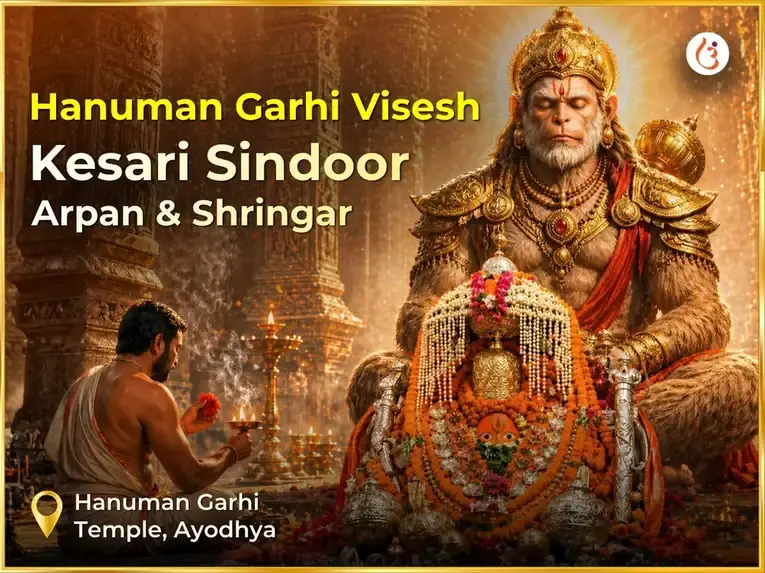
* Mangalvar Special Weekly Hanuman Chalisa Paath: Have the complete Chalisa recited for you at Hanuman Garhi, Ayodhya. Dakshina starts from ₹251.
* 11 Mukhi Hanuman Bajrang Baan Path: A powerful ritual for removing persistent obstacles and fears.
* 108 Akhand Sundarkand Path & Chola Shringar: A comprehensive offering for major life events and seeking profound blessings.
When you participate, pandits chant your Name and Gotra in the Sankalp, and you receive a video of the puja along with authentic temple prasad delivered to your home.
Sources & References
Scriptural Authority:
* Ramcharitmanas, Goswami Tulsidas (16th Century) - The primary epic from which the devotion and character of Hanuman are derived.
* The composition of the Hanuman Chalisa is traditionally attributed to Goswami Tulsidas as part of the oral and written Bhakti tradition.
Temple Verification:
* Puja vidhi and benefits are cross-referenced with practices at verified temples on the Utsav platform, including Hanuman Garhi, Ayodhya.
Related Pujas on Utsav:
* Mangalvar Special Weekly Hanuman Chalisa Paath
* 11 Mukhi Hanuman Bajrang Baan Path