En
En
The Narayan Kavach (नारायण कवच) is Lord Vishnu's divine armor, a sacred hymn designed for ultimate protection against all forms of negative energy, fear, and worldly dangers. Its origin is detailed in the Srimad Bhagavatam (Canto 6, Chapter 8), where it was given by the sage Vishwaroopa to Indra. Chanting it creates a powerful spiritual shield around you.
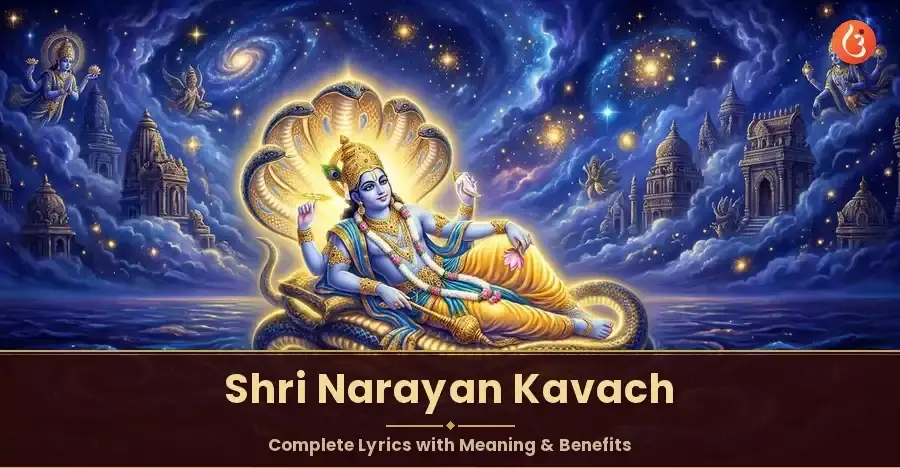
The story behind this divine armor is one of the most compelling tales of faith and protection, as narrated in the Srimad Bhagavatam (श्रीमद्भागवतम्), Canto 6. King Indra, the ruler of the heavens, found himself overwhelmed by the power of the great demon Vritrasura. Vritrasura was not an ordinary demon; he was born from a sacrificial fire specifically to kill Indra, making his power immense and his purpose unshakeable. Fearful and on the brink of defeat, he sought the counsel of the great sage Vishwaroopa. It's a classic story of a devotee in distress seeking a higher power.
Vishwaroopa didn't just offer advice; he bestowed upon Indra a spiritual weapon of immense power - the Narayan Kavach. He explained that this wasn't just a collection of words, but a divine shield (Kavach) that invokes Lord Narayan's presence to protect every part of the chanter's body and mind. Armed with this Kavach, Indra regained his confidence, faced Vritrasura, and emerged victorious. This powerful origin story is why devotees today still turn to it for protection.
This is the complete text for recitation. It begins with nyasa (consecrating the body) and then proceeds to the main Kavach.
Om Namo Narayanaya
Om namo bhagavate tasmai visnave prabhavisnave
Namas te vasudevaya visnave sarva-jisnave
Om harir vidadhyan mama sarva-raksam
Nyastanghri-padmo patagendra-prsthe
Darari-carmasi-gadesu-capa-pasan
Dadhano 'sta-guno 'sta-bahuh
Jalesu mam raksatu matsya-murtir
Yado-ganebhyo varunasya pasat
Sthale su mayavatu-vamano 'vyat
Trivikramah khe 'vatu visvarupah
Durgesv atavy-aji-mukhadisu prabhuh
Payan nrsimho 'sura-yuthaparih
Vimuncato yasya mahatta-hasam
Diso vinedur nyapatams ca garbhah
Raksatv asau madhvani yajna-kalpah
Sva-damstrayonnita-dharo varahah
Ramo 'dri-kutesv atha vipravase
Salaksmano 'vyad bharatagrajo 'sman
Mam ugra-dharmad akhilat pramadan
Narayanah patu narah ca hasat
Dattas tv ayogad atha yoga-nathah
Payad gunesah kapilah karma-bandhat
Sanat-kumaro 'vatu kamadevad
Dhayasirsa mam pathi deva-helanat
Devarsi-varyah purusarcana-ntarat
Kurmo harir mam nirayad asesat
Dhanvantarir bhagavan patv apathyad
Dvandvad bhayad rsabho nirjitatma
Yajnas ca lokad avatad janantat
Balo ganat krodha-vasad ahindrah
Dvaipayano bhagavan aprabodhad
Buddhas tu pasanda-gana-pramadat
Kalkih kaleh kala-malat prapatu
Dharmavanayoru-krtavatarah
Mam kesavo gadaya pratar avyad
Govinda asangavam atta-venuh
Narayana prahna udatta-saktir
Madhyan-dine visnur arindra-panih
Devo 'parahne madhu-hogradhanva
Sayam tri-dhamavatu madhavo mam
Dose hrsikesa utardha-ratre
Nisitha eko 'vatu padmanabhah
Srivatsa-dhama-para-ratra isah
Pratyusa iso 'si-dharo janardanah
Damodaro 'vyad anusandhyam prabhate
Visvesvaro bhagavan kala-murti
Understanding the meaning transforms recitation from a ritual into a deep, personal experience. Here’s what you’re invoking.
You begin by bowing to Lord Narayana (Vishnu) and purifying your body. The opening verses call upon Hari (Vishnu) seated on Garuda, holding his eight divine weapons - conch, discus, shield, sword, mace, bow, arrows, and rope. You're essentially asking this all-powerful form to establish a protective presence.
The Kavach then assigns a form of Vishnu to protect you at every hour of the day. Keshava in the morning, Govinda at forenoon, Narayana in the afternoon, and so on, covering every moment until the next dawn. This comprehensive invocation ensures that no moment, whether during work or rest, is left unguarded. It's a 24/7 spiritual security system.
According to the Phala Shruti (the section of a text describing the results of chanting it), the benefits are immense and life-altering. This isn't just a simple prayer; it's a recalibration of your spiritual energy.
Spiritual & Karmic Benefits:
Practical, Daily Life Benefits:
To get the full benefit, there's a recommended method (vidhi) that aligns your intention with the energy of the hymn. Following the proper procedure helps focus the mind and shows reverence for the sacred text. It's not complicated, but it is important.
While this Kavach is for everyone, it is especially powerful for certain individuals. Do you see yourself in this list?
Reciting the Narayan Kavach is a personal practice. You can amplify its effects by participating in pujas performed by verified pandits at sacred temples. This combines your personal devotion with the power of formal ritual.
Recommended Pujas for Devotees of Lord Vishnu:
When you Participate through Utsav, pandits chant your name and gotra in the Sankalp, and you receive a video of the puja along with authentic temple prasad delivered to your home.
The Narayan Kavach is not a standalone work but an integral part of the Srimad Bhagavatam (Bhagavata Purana), found in Canto 6, Chapter 8. The authorship of this entire Purana is traditionally attributed to the great sage Maharishi Veda Vyasa, who is also credited with composing the Mahabharata. The hymn is composed in classical Sanskrit and is embedded within the narrative framework where the sage Shukadeva Goswami recounts it to King Parikshit. As part of this revered Vaishnava scripture, it has been preserved and transmitted for centuries through the unbroken oral tradition of Puranic recitation and the guru-shishya parampara (master-disciple lineage), cherished by devotees as a divine protective shield passed down directly from the sacred text.
Scriptural Authority:
* Srimad Bhagavatam (Bhagavata Purana), Canto 6, Chapter 8: The primary and undisputed source of the Narayan Kavach.
Recitation & Vidhi Tradition:
* The recitation method is based on traditional practices followed in Vaishnava Sampradayas and as guided by experienced pandits.
Related Pujas on Utsav:

Rahu Paithani Temple, Paithani
Sat - Nov 28, 2026 - Shanivar Visesh